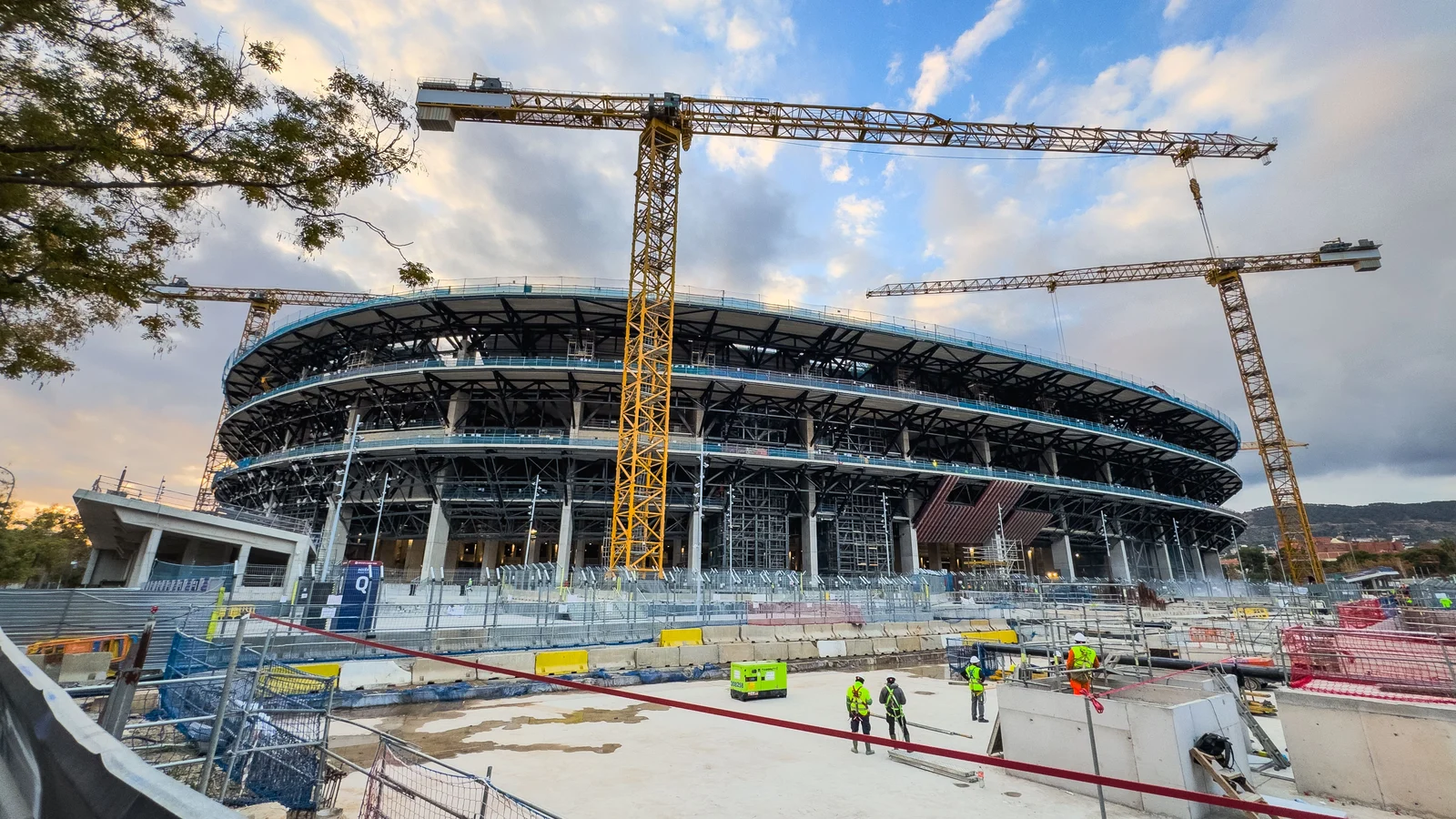
Barcelona’s supporters have already had their homecoming. The club is still waiting for the full payday. Almost a year after football returned to Camp Nou, the roof and the most lucrative parts of the rebuilt ground remain unfinished, while Barcelona continues paying for a transformation designed to change what it can afford on the pitch. 12, 13
On 13 November, another €300 million arrived through a bond issue placed by Goldman Sachs. It takes the stadium’s financing plan to around €1.8 billion, a sum the board says will be enough to finish. There is also €210 million of separate borrowing to keep the club going while it waits for the extra income. Barcelona is financing both the building and the awkward years before the building can earn everything expected of it. 01, 03, 27
The attraction is easy to understand. Camp Nou gives Barça a chance to turn its enormous following into a much better stadium business, with more hospitality, a larger visitor operation and commercial spaces that can make money between matches. The challenge is that the lenders have started collecting before that business is fully open.
From €600m to €1.8bn
When members backed Espai Barça in 2014, the plan was for a €600 million redevelopment encompassing the stadium and the wider campus. By 2021, the club was asking for authority to raise up to €1.5 billion. The design, ambition and funding arrangements had all moved on. In April 2023, Barcelona announced a €1.45 billion financing agreement with 20 investors and could finally get on with the main stadium works. 06, 05, 04
The original structure was later detailed as roughly €987 million of bonds and €491 million of loan facilities, together €1.478 billion within the €1.5 billion financing ceiling. The money came from investors and lenders expecting repayment from the stadium’s future business. 05, 20, 30
The sales pitch was compelling for a member-owned club. Barcelona would keep its stadium and its ownership model, avoid mortgaging its property and repay investors from the extra business created by the redevelopment. Better facilities would bring in more money, that money would pay for the work, and Barça would emerge with a home capable of supporting its sporting ambitions for decades. 04, 05
In September, members were asked for another €300 million. Ferran Olivé, the club’s economic vice-president, was asked whether this would finally be enough. His answer was emphatic: another extension would not be needed. The board’s current plan is to complete the stadium within roughly €1.8 billion of financing. 03, 27
That figure covers more than the builder’s work. Arranging the debt, financing construction and maintaining reserves also require money. Barcelona will then keep paying interest over the life of the borrowing. The new Palau Blaugrana, meanwhile, needs its own funding arrangement, which the club says will sit outside the stadium extension. 08, 28
| Money raised or arranged | What it pays for |
|---|---|
| Previous stadium financing envelope: €1.5bn | The redevelopment and its associated funding requirements. 03 |
| Additional stadium bonds: €300m | The remaining works, taking the financing plan to around €1.8bn. 01, 03 |
| Separate television-backed borrowing: €210m | Club cash needs during the wait for full stadium income. 02, 09, 10 |
| Earlier refinancing: €424m in 2025 and €84m in 2026 | Paying off earlier lenders and arranging new repayment terms. 07, 08 |
Barcelona has also been buying itself more time to repay. In June 2025, it replaced €424 million of debt due in 2028 with bonds repayable between 2033 and 2050, at an average cost of 5.19%. Another €84 million refinancing followed in July 2026. The club exchanged earlier borrowing for new loans with different terms, moving payments further down the road. November’s €300 million gives it fresh money to spend on completion. 07, 08
SportsGlare Data 01
How the plan reaches €1.8bn
Stadium financing envelope, € million. Refinancing is not added again.
Original notes
Original loan facilities
Bridge to ceiling
Additional bonds
Current plan
The grey €22m reconciles the €1.478bn original structure to the €1.5bn ceiling. It is not a separate identified cash issue. €508m of refinancing changes lenders and terms, rather than adding funding. Sources: S05, S20, S30, S01.
The expensive surprises inside the old ground
Part of the problem was hidden in the stadium Barcelona wanted to preserve. The protected second tier needed more than 3,000 reinforcement interventions, against roughly 800 originally envisaged. The club also points to regulatory changes and the difficulty of opening sections while construction continues. Alongside those complications, it has expanded the hospitality, museum and technology offer in pursuit of higher future revenues. 02
That is how a redevelopment can become more expensive in two directions at once. The old building demands work that was not expected; the new business invites additions that promise to pay for themselves later. Meanwhile, the timetable stretches and the club spends longer without access to the ground it is paying to create.
The original schedule envisaged a partial return in December 2024 and completion in July 2026. Barça finally played at home again on 22 November 2025, and the capacity available to supporters reached 62,652 the following March. The return restored an important part of the matchday business, but the finished stadium and its full earning power were still some way off. 11, 12, 18
A fresh deal with Limak, and another move out
November brought a reset with Turkish contractor Limak. SER Catalunya reported that a newly signed agreement removed penalties associated with the delays already accumulated, including the original €1 million-a-day provision, subject to the revised timetable. Recovering money under the old clause would have depended on establishing responsibility for the delays. 26
By 16 November, Mundo Deportivo was reporting an agreed final programme, backed by investors, that kept Limak responsible for finishing the job, including the roof. The plan is to start the roof work after this season and bring supporters back into all three tiers during the second half of 2027/28. The double ring of VIP boxes is expected to be fully operational in 2028/29. 13
Getting there means leaving again. Montjuïc has reportedly been reserved for the whole of 2027/28 as a precaution, although the planned return is earlier. Barcelona has secured the extra financing and kept its contractor in place, but still faces another interruption before supporters and hospitality customers can use the completed ground. 13
SportsGlare Data 03
The homecoming was not the finish
Original targets, completed events and the reported next stages.
- Original targetOriginal partial-return target
- Original targetOriginal completion target
- ActualFootball returned to Camp Nou
- ActualAvailable capacity reached 62,652
- Reported programmeRoof works and another temporary move
- Reported programmeReturn with all three tiers
- Reported programmeFull operation of the double ring of VIP boxes
Original targets are shown separately from actual events and reported future periods. Montjuïc has reportedly been reserved for the whole of 2027/28 as a precaution. Sources: S11–S13, S18.
The cost of waiting reaches beyond the construction site. Barcelona still has a team to field and a club to run while some of its future income remains behind the builders’ barriers. That is where the separate €210 million comes in: two €105 million issues, placed in July and October, supported by future television revenues. July’s bonds carry a 5.14% fixed coupon and mature in October 2036. 02, 09, 10
Together, the stadium financing and this liquidity package amount to €2.01 billion. The television-backed borrowing helps Barcelona through the transition, but commits another slice of future income to repayments. Morningstar DBRS identifies the pressure clearly: more borrowing at the stadium leaves less money flowing back to the club, which still has its own creditors to pay. 03, 14, 15
A better business, with lenders at the front of the queue
There are good reasons to believe Camp Nou can become a much stronger business. A supporter buying an ordinary ticket, a company entertaining clients and a visitor touring the museum are paying for different experiences. A properly equipped stadium can serve all three, with restaurants, premium spaces and year-round attractions giving the club more opportunities to sell than the fixture list alone provides.
Barcelona already has a buyer for the name above the door. Spotify’s stadium agreement runs to 2034, with Mundo Deportivo reporting a €20 million annual naming fee from 2026. The rebuilt ground should also give Barça far more hospitality to sell. These are valuable businesses for a club that controls its home and can develop the commercial offer around it. 16, 17
Some of that future value has already been sold through 30-year personal seat licences. The accounts recorded €71.6 million of licence revenue in 2024/25, followed by €9.5 million in 2025/26. Selling those rights can bring money forward, although collection has had complications: a later agreement returned 142 licences to the club and wiped out €28.4 million still owed to Barça. Those seats can be sold again, but the episode shows why the cash arriving matters as much as the value booked. 08
The lenders have an interest in that cash arriving too. Under the original arrangement, Barcelona expected to retain the first €100 million from the relevant stadium revenues before the next €100 million went towards debt service. The financing extension changes the queue. Europa Press reported Olivé telling September’s assembly that the first €100 million would temporarily go towards paying investors before reaching the club. Returning to the earlier arrangement is reported to depend on completion and commercial milestones. 05, 03, 19
For Barcelona, that makes finishing the hospitality areas especially urgent. A fuller ground should mean more sales, but the club needs those sales to grow far enough beyond its financing obligations to leave meaningful money for football. Until then, supporters can see a busier stadium while the club’s cash position remains tight.
SportsGlare Data 02
Who gets the first €100m?
Cash-payment priority. A schematic, not the complete financing contract.
Original explanation
- First €100mReserved for the club
- Next €100mStadium debt service
- ExcessReturns to the club
Reported transition
- First €100mStadium debt service takes priority
- Club distributionsFollow the creditor-priority step
- Earlier arrangementReportedly depends on completion and commercial milestones
The €100m describes order, not a cap on all annual debt service. The temporary priority is attributed to September’s assembly reporting. Sources: S05, S03, S19.
The Barça that has to pay for all this
The stadium is only part of what future Barcelona teams will inherit. In 2022, the club sold Sixth Street 25% of its LaLiga television rights for an announced 25-year term. For every €100 covered by the agreement, €25 goes to the investor. The remaining €75 still has to help run the club and meet its debts. 29
Crónica Global reported Sixth Street’s contribution at €518.5 million across the two transactions. The €667 million recorded by Barcelona also included the club’s own contribution to the deal structure. The outside funding was therefore substantially smaller than that headline accounting figure. 33, 34, 35
At €160 million a year in covered income, the investor’s quarter would take €40 million out of Barça’s annual budget. Hold that income flat for 25 years and the surrendered receipts reach €1 billion, €481.5 million more than the reported upfront funding. Spread those year-end payments over the full term and the exchange works out at an equivalent annual financing rate of about 5.9%. That comparison includes all the payments, with no further principal bill at the end. 32
Growth would make each missing television cheque larger. For scale, 1% annual growth would turn the same uninterrupted 25-year stream into about €1.13 billion; 2% would take it to €1.28 billion. Recent history supports modest assumptions: Barça’s published allocation was €165.6 million in 2020/21 and €162.5 million in 2023/24, with the later figure including LaLiga’s adjustment for clubs outside CVC. The next domestic rights cycle, covering 2027–2032, is worth 9% more than its five-year predecessor, equivalent to roughly 1.7% annualised growth between cycles. Individual club allocations also depend on international sales and the distribution formula. 32, 36, 37
The contract can respond to that growth. Barça disclosed buyback provisions and said the first 10% tranche could run for between 20 and 30 years depending on television-income growth. Crónica Global reported a €1.037 billion investor-receipts threshold linked to recovering the rights. Faster growth could bring that recovery forward, rather than leave Sixth Street collecting a rising share for the full 25 years. The €1.13 billion and €1.28 billion examples show the scale of an uninterrupted revenue sale; the buyback terms determine how much of that stream the investor ultimately receives. 33, 34, 35
The price alone does not make this an obviously reckless bargain. Cash in a crisis can be worth paying for, and the investor takes exposure to future television revenues. The harder question is what Barcelona achieves with the breathing space. A sustainable recovery would justify bringing income forward. Keeping spending ahead of earnings would leave future boards with the same problem and a smaller television cheque. Camp Nou has to help replace that missing income while paying its own lenders.
The media borrowing places another demand on future cash. In 2026 alone, Barcelona added €210 million of Media Notes with final maturities in October 2036. The club retains the income supporting those loans, but enough of it must go to the lenders to meet interest and repayments. 09, 10, 15
SportsGlare Data 04
A quarter of LaLiga TV income is already sold
For each €100 covered by the Sixth Street agreement.
The split applies to LaLiga television rights only. The announced 25-year term is subject to buyback provisions and contractual adjustments, including growth-related duration changes. The stadium debt is separate. Sources: S29, S33, S34, S09, S10, S15, S08.
Those commitments become harder to carry in a weak season. European income can fall and expensive hospitality can be harder to sell, while scheduled debt payments still arrive. A future board would have less room to rebuild the team without cutting spending, selling players or refinancing again. Camp Nou offers the prospect of escaping that cycle by creating a bigger business. Barcelona needs the extra earnings to grow faster than the demands already placed on them.
The repayment dates, and the price of buying time
The next sizeable stadium repayment is around €119 million in June 2028, based on the June 2026 balances of two original bond issues. Other existing batches, with balances of approximately €220 million and €237 million, mature in 2030 and 2032. Two further issues mature in 2043 and 2047, while the €424 million and €84 million refinancings are scheduled for repayment across 2033–2050. 20, 30, 31, 07, 08
That gives Barcelona a long runway, with several points at which it must either find substantial cash or persuade investors to lend again. The separate €210 million of 2026 Media Notes has final maturities in October 2036. For November’s new €300 million stadium issue, Reuters reported a 30-year term while the financing was being prepared; the club’s completion notice did not publish the detailed repayment schedule. 09, 10, 24, 01
SportsGlare Data 05
The repayment calendar stretches to 2050
Legacy stadium maturities and dated outstanding principal balances, € million.
Maturity dates and outstanding balances are not necessarily single balloon payments. €508m is a total over the repayment period, not an annual payment. Balances include dated euro conversions of dollar debt. Sources: S20, S30, S31, S07–S10.
The interest alone is a substantial business expense. At its original €424 million balance, the 2025 refinancing’s 5.19% rate represents about €22 million a year. July’s €105 million Media Notes at 5.14% represent another €5.4 million a year at their initial balance. Those are just two parts of the wider borrowing. 07, 09, 32
To see the scale of the whole stadium plan, a 5–7% rate on €1.8 billion would mean roughly €90 million–€126 million of interest for a year at that balance, before returning any principal. A simple 30-year repayment example at 6%, with equal annual payments, produces a bill of about €131 million a year and around €2.1 billion of interest over the term. The actual bond series have different rates and payment dates; the example shows how a €1.8 billion investment can require much more than €1.8 billion of future cash. 32
SportsGlare Data 06
What buying time could cost
Illustration: €1.8bn repaid over 30 years at constant interest rates.
Illustration, not Barcelona’s contractual lifetime payments. Equal annual year-end payments; constant rates; no grace period, fees or refinancing. Excludes the separate €210m Media Notes. Source: S32.
When does Camp Nou start paying Barça back?
The club’s consultants expect the completed project to generate around €250 million more in annual revenue than the old facilities. That would give Barcelona a substantial new source of income, provided the hospitality sells, visitors keep coming and the expanded operation earns enough after its running costs. Staff, catering, maintenance and financing will all take a share before the proceeds can strengthen the team. 08
At the Bernabéu, the annual cost of a rebuilt stadium is already visible. Real Madrid reported €1.347 billion invested by June 2025 and €1.132 billion of stadium debt still outstanding. In 2024/25, it paid €60 million to service that borrowing, including €23 million of principal. Barcelona is pursuing the same broad opportunity: accept a large, long-term financing bill in exchange for a stadium that can earn much more. 21
Control of that business is a considerable advantage. As SportsGlare’s Bordeaux reporting showed, a club can end up paying heavily for a modern venue while having little freedom to develop its commercial potential. Barcelona can shape the visitor experience, sell the hospitality and build lasting partnerships around its own home. It has more ways to make the investment work. 22
The frustration is how long it is taking to put all those advantages to use. Every delayed opening postpones sales, while interest keeps accruing and the football club needs money today. The latest €300 million and the agreement with Limak give Barcelona a route to the finish. The reward would be a stadium that helps fund the team for decades. For now, Barça is still borrowing to reach the point where Camp Nou can start returning the favour.
Sources
Sources below support the numbered references. Accessed 19 November 2026. Annual-account references use printed page numbers where available.
Club, regulator, commercial counterparty and rating agency
- S01. FC Barcelona, €300m completion announcement, 13 November 2026. Amount, CNMV authorisation as reported by the club and sole placement agent.
- S02. FC Barcelona, additional financing approval, 19 September 2026. Separate stadium and audiovisual packages, construction explanation, Montjuïc costs and €1.485bn reference.
- S04. FC Barcelona, original financing announcement, 24 April 2023.
- S05. FC Barcelona, financing disclosure, 14 June 2023. Member authorisation, financing components, security description and modelled financing cost.
- S06. FC Barcelona, 2014 referendum proposal. Original investment and funding split.
- S07. FC Barcelona, €424m refinancing, 27 June 2025.
- S08. FC Barcelona, audited 2025/26 consolidated accounts. Notes 2, 7, 14.1, 18.1 and 23; printed pages 263, 294–295, 315, 330 and 338. Drawdown, additional-revenue forecast, July replacement financing and seat licences. The Spanish version says the Catalan original prevails in case of discrepancy.
- S09. FC Barcelona, first €105m placement, 17 July 2026.
- S10. FC Barcelona, second €105m placement, 23 October 2026.
- S11. Espai Barça, project FAQs. Historical timetable. This page still contains obsolete target dates, which are used only as original targets.
- S12. FC Barcelona, return to Camp Nou. Confirms 22 November 2025.
- S14. Morningstar DBRS, Series H and I rating, 6 November 2026.
- S15. Morningstar DBRS, credit review, 9 July 2026. Explains project debt and reduced distributions to the club.
- S16. Spotify, partnership extension, 17 October 2025. Contract duration, without a disclosed fee.
- S18. FC Barcelona, Phase 1C occupancy announcement, March 2026. Official URL as indexed, including its unusual ending; capacity 62,652.
- S20. CNMV, Espai Barça fund return, 30 June 2026. Pages 1–5 and 16–20, especially tables S.05.2 A–E. Reporting-period register.
- S21. Real Madrid, 2024/25 financial results, 17 July 2025. Historical comparison only.
- S23. CNMV, original fund and series registration.
Original reporting and related coverage
- S03. Europa Press, assembly financing approval, 19 September 2026. Source for the €1.5bn-to-€1.8bn ceiling.
- S13. Mundo Deportivo, Limak completion agreement, 16 November 2026. Original reporting on the latest construction programme and commercial opening targets.
- S17. Mundo Deportivo, Spotify fee breakdown, 17 October 2025. Reported €20m annual stadium naming element.
- S19. Crónica Global, creditor-priority conditions, 26 September 2026. Includes reproductions of club presentation slides; the underlying amended financing deed has not been obtained.
- S22. SportsGlare, Bordeaux ownership and stadium analysis. Verified live internal link.
- S24. Reuters via CNA, financing structure, 24 September 2026. Pre-issue 30-year maturity reporting and separate audiovisual liquidity package.
- S25. The Esk, financing update, 17 November 2026. Research lead and supplementary analysis; not a substitute for transaction documentation.
- S26. SER Catalunya, revised Limak contract, 5 November 2026. Original reporting on treatment of accumulated-delay penalties.
- S27. Mundo Deportivo, members' questions and board answers, 19 September 2026. Directly reports Olivé's assurance that another financing extension would not be required.
- S28. Mundo Deportivo, assembly explanation of additional costs and Palau funding, 19 September 2026. Club position that the Palau sits outside the €300m extension and requires alternative funding.
- S29. FC Barcelona, additional Sixth Street agreement, 22 July 2022. Official announcement of the aggregate 25% LaLiga rights sale for a stated 25-year term. Roughly 2047 is the implied end of that announced term; buyback rights and contractual adjustments can affect duration.
- S30. Crónica Global, remaining June 2028 maturities and financing structure, 14 November 2026. Original tranche composition, loan refinancings and the two remaining 2028 bond issues, corroborated against the CNMV filing and club accounts.
- S31. Crónica Global, original bond-series calendar, 16 March 2025. Calendar years for A1–A8. Use this source for legacy dates only. Amounts use the later June 2026 CNMV return; subsequent loan refinancing comes from the club's 2025/26 accounts.
- S32. SportsGlare calculations, supplied in chart data and
build_barcelona_future_graphics.py. Simple annual interest equals principal multiplied by rate. The 30-year illustrations use equal annual year-end payments:payment = principal × rate / (1 − (1 + rate)^−30); total interest equals30 × payment − principal. No grace period, refinancing, fees or extra borrowing is included. The €1.8bn principal and 5%, 6%, 7% rates are scenario inputs, not a reconstruction of the signed repayment schedule. The separate television-rights example assumes €160m annual covered income held flat: 25% = €40m a year; 25 years = €1bn nominal receipts. Nominal income surrendered less reported upfront funding is €1bn − €518.5m = €481.5m. The financing comparison solves €518.5m = sum of €40m / (1 + r)^t for t = 1 to 25, giving r ≈ 5.854% with annual year-end receipts and no terminal principal repayment. This is a modelled equivalent rate, not a contractual coupon. The reported €1.037bn recovery threshold less €518.5m of funding gives a €518.5m nominal gap. These are full-term estimates from the 2022 transaction, not amounts still outstanding in November 2026, and the illustrative €160m base is not a forecast of actual distributions. Contractual growth adjustments and buyback terms can alter the duration. Growth sensitivities assume an uninterrupted 25-year stream starting at €40m in year one: total = €40m × sum((1 + g)^t, t = 0…24). At 1% this is €1,129.728m; at 2%, €1,281.212m. These deliberately exclude buyback or early termination and are not forecasts of actual investor receipts. The annualised domestic-cycle comparison is (1.09)^(1/5) − 1 = approximately 1.74%.
- S33. FC Barcelona, members approve first Sixth Street sale, 9 October 2022. First tranche: €207.5m investor capital, €60m club contribution and €267m recorded income. Buyback right and a 20–30-year duration depending on television-income growth.
- S34. FC Barcelona, ratification of second rights sale, 9 October 2022. Second tranche recorded at €400m, aggregate recorded amount €667m, and explanation of buyback provisions.
- S35. Crónica Global, Sixth Street contributions and rights-recovery terms, 7 October 2022. Reports €518.5m investor capital across the two transactions. The article uses that reported contribution, rather than treating the €667m accounting amount as outside funding.
- S36. LaLiga, domestic rights award for 2027/28–2031/32, 28 November 2025. Total domestic rights €6.135bn, up 9% against the preceding five-year cycle; residential rights €5.25bn, up 6%. The annualised 9% comparison is a SportsGlare calculation, not a promised annual escalator.
- S37. LaLiga club-allocation disclosures: 2020/21 official document, with €165.6m also reproduced in AS, 29 December 2021; 2023/24 official disclosure, with the €162.49m CVC-adjusted amount reported by EFE, 18 December 2024. These are published allocations, before the Sixth Street sale, not a like-for-like index of the league's underlying rights prices.