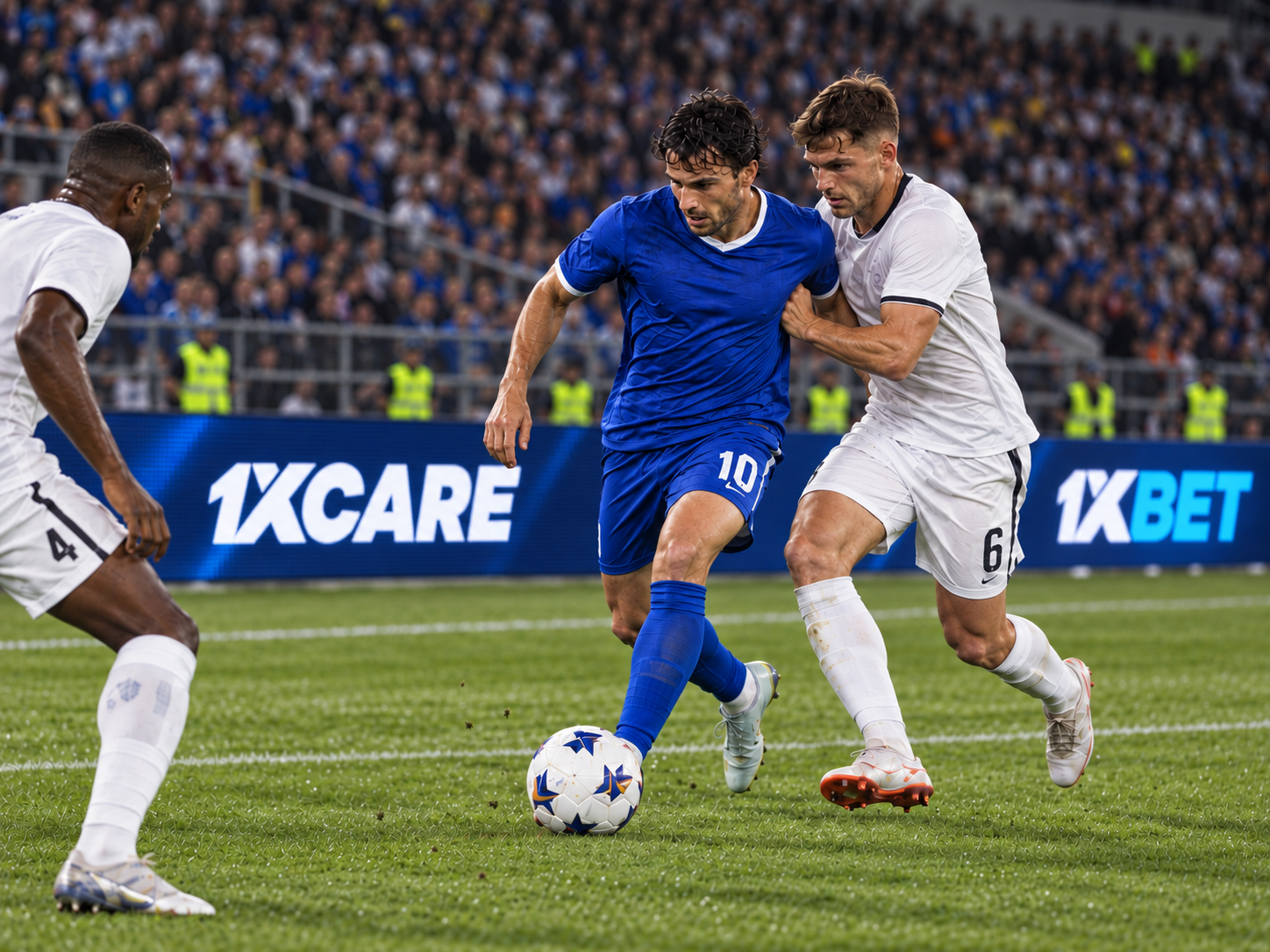
1xCare is asking football to give 1xBet a moral reset. Its website promises research, education, technology and support, and says its decisions are guided by player protection rather than commercial priorities. Football should decline the invitation.
1xCare was created by the owner of the global 1xBet trademark. Its chair, Simon Westbury, is a strategic adviser to 1xBet, leading the group’s expansion into regulated markets and overseeing 1xCare’s policy and funding allocation. The people paying for the protection initiative are not separate from the business whose record it is meant to soften.
A 1xBet name with ‘bet’ removed
The name is not incidental. 1xCare keeps the distinctive 1x that makes 1xBet recognisable, while replacing the word that describes the underlying product with “Care”. It gives the same commercial orbit a welfare-facing identity without severing the association with 1xBet. That is why 1xCare should be seen as a 1xBet family brand by design, not as an outside body examining the company from a distance.
Westbury made the commercial logic plain in the launch interview. Build trust through player protection and a safe environment, he said, and players stay longer. That benefits both sides. Strip away the industry language and the proposition has a far uglier equivalent: the drug dealer who does not want their addicts to die because dead addicts do not keep buying. Retention is not care. It is the economics of keeping a vulnerable customer active inside the product.
That is why 1xCare cannot be treated as a remedy for 1xBet’s record. It is a credibility exercise created by the same commercial system. That system has included betting markets involving 14- and 15-year-old players, a court-backed bankruptcy case involving claimed unpaid winnings, state investigations into mirror websites and payment mechanisms, and an amateur-sport content line that looks less like sport than a production factory.
The issue for football is no longer whether 1xCare can produce a respectable research paper. It is whether clubs, leagues and players should keep lending their legitimacy to a gambling network that built its reach this way.
2014 to 2019: Russian roots and early warnings
Bellingcat identifies Roman Semiokhin, Dmitry Kazorin and Sergey Karshkov as the three Russian founders. Follow the Money reports that all three were named in a Russian criminal case over illegal gambling and unpaid taxes, and that Russia had issued an international arrest warrant before the full-scale invasion of Ukraine. The same investigation documents that the founders were placed on Ukraine’s sanctions list, alongside 1xBet-linked Curaçao entities. Bellingcat cites a 2021 Bryansk Investigative Committee release saying the operation had generated more than ₽63 billion in illegal-gambling revenue (about US$737m at the 10 September 2026 reference rate).
The Dutch regulator later found that 1X Corp N.V. and Exinvest Limited offered online gambling without a licence through 1xbet.com, xbet-1.com and at least 83 other websites between February and July 2018. The resulting €400,000 penalty (about US$465,000) became final after the appeal was withdrawn. The regulator named the entities, the domains, the period and the penalty.
In 2019, Chelsea, Liverpool and Tottenham ended 1xBet relationships after The Sunday Times reported cockfighting streams, a “pornhub” casino and sexualised promotion linked to the bookmaker’s UK site. This was not a new question for football.
2021 to 2023: when the customer wins, and the company disappears
For all the industry’s talk of frictionless journeys, gambling has one elementary test. When a customer wins, can they get paid?
SportsGlare’s earlier investigation, 1xBet: You Won the Bet. Now Try Getting Your Money., follows the withdrawal disputes and legal records behind that question in detail.
The 1XCorp N.V. bankruptcy case in Curaçao is unusually useful because it is a court record, rather than a collection of online complaints. In August 2021, a Curaçao foundation representing affected online-gambling players petitioned for 1XCorp’s bankruptcy. The Dutch Supreme Court’s Procurator General records that the foundation said a number of players had assigned it claims arising from online gambling on 1XCorp’s website, that the claims had not been paid, and that other debts were also left outstanding.
By April 2022, the claims put before the court totalled NAf 1,648,733.11 (about US$921,000). The Common Court of Justice declared 1XCorp bankrupt in May 2022. Its judgment found that the foundation had established multiple claims from different players and that 1XCorp was in a state of having ceased payment. The Procurator General’s opinion notes that the claims concerned players who said their winning amounts had not been paid, and that the company’s payment of some other winning players did not alter the finding. In January 2023, the Dutch Supreme Court rejected 1XCorp’s appeal.
The distinction is important. The claimants were pursuing 1XCorp, not an abstract name called “1xBet”. Bellingcat identifies 1XCorp as the brand’s parent company. The court record establishes that its online-gambling operation was put into bankruptcy after a foundation representing players with claimed unpaid winnings succeeded in court. That is already a serious failure of the customer relationship that 1xCare now says it wants to improve.
Player protection starts before a bet is accepted, but it cannot end there. An operator’s promises about behavioural monitoring and safer play do not have much moral force if a court has found it had ceased paying creditors whose claims arose from winning bets.
The bankruptcy did not end the business. Follow the Money found that 1xBet continued from the same Willemstad address through Acom Latin America N.V. The director of the trust company representing Acom accepted that there was a relationship with 1xBet, but described it as a franchise agreement with the undisclosed brand owner. That is not transparency. It is an operating structure in which the public is told to distinguish the brand, the licensee, the franchisee and the hidden owner while losing customers try to identify whom they are meant to sue.
Follow the Money’s 2023 investigation makes the scale visible. Its researchers identified more than 50 networks using different brands and legal entities which, through the software and promotional material they carried, appeared connected to the 1xBet network. Together they ran more than 1,000 websites aimed at more than 200 countries. In the 1xBit cryptocurrency-casino part of that network, the investigators analysed more than 250 wallets involved in over three million transactions worth €4 billion (about US$4.65bn), and reported regular transfers to and from mixers, including Tornado Cash.
This is the model 1xCare is asking people to regard as the foundation for a new conversation about trust: a brand that survives the collapse of one company, disperses through a network of domains and legal names, and keeps a route open to customers long after the regulatory and consumer-protection failures are known.
June 2023: the reported death of Sergey Karshkov
Karshkov’s death has not been independently established in the public record. The only named source for the reported death and its cause is his friend Pavel Muntyan, who said on social media that Karshkov had died in a Swiss clinic after an MRI contrast reaction. Vedomosti and The Moscow Times both attribute the explanation to Muntyan. Neither identifies a clinic, a canton, a medical authority, a coroner or police authority.
The available Swiss procedure shows what independent material would ordinarily be generated. In Canton Zurich, a doctor must certify a death and classify it as natural, non-natural or unclear; a police notification follows where it is not classified natural. A body transported from Switzerland abroad requires a cantonal Leichenpass. Yet SportsGlare has located no public medical statement, police or prosecutor record, civil-registry entry, transit document, death certificate, funeral notice, funeral photograph, named cemetery or grave record. A Bryansk outlet said relatives intended to bury Karshkov in the city, but named no cemetery or produced a burial record. Another local outlet publicly speculated about a possible new identity, while acknowledging that it did not know what had happened.
A private document that has never been identified is not public verification. The reported death of a wanted 1xBet co-founder therefore rests, in the public record, on a friend’s social-media statement rather than any independently identifiable authority or document. The claimed return to Bryansk for burial supplies no independent confirmation either.
This is a Russian-founded, offshore gambling network whose commercial footprint has been organised through offshore entities, proliferating domains and jurisdiction-by-jurisdiction access systems. That context matters when the same business is seeking acceptance in regulated markets under the banner of responsibility.
2024: the sports factory
Bellingcat’s reporting opens on a scene that captures what this betting product had become.
In a curtained-off gym, six men played short football under the names Arsenal and Real. There were no spectators. One camera filmed from one end of the pitch. When the game finished, the players changed shirts, returned as different teams and played again. On another court, the schedule kept going through the night.
That scene came from a 1xBet stream examined by Bellingcat in its 2024 investigation into the bookmaker’s amateur-sport offering. The reporting is not based on a disgruntled punter or an anonymous tip. Bellingcat reviewed hundreds of streams, checked player and league material, and geolocated venues through visible architectural details, signs, reverse-image searches and social posts.
Its central number is startling. In a 24-hour period in September 2024, Bellingcat counted 1,297 short-football games streamed to 1xBet. The investigator compared that single day with the combined 1,066 league fixtures played in an entire Bundesliga, Premier League and La Liga season. The precise annual extrapolation matters less than the point it proves. This was not an occasional market in an obscure sport. It was a system designed to supply continuous betting inventory: not sport made for sporting interest, but a way of keeping somebody already inside a gambling app supplied with something to wager on at every hour. That is particularly dangerous for people struggling to control their gambling.
The reporting also identified the venues. One of them was the Alexander Stepin Football School in Bryansk, a children’s football school. Bellingcat matched distinctive features from the streams, including the roller door, windows, scoreboard, pitch markings and branding, to images published by the school.
Another stream carried a women’s floorball match in Severodvinsk. By cross-checking player profiles, names and shirt numbers, Bellingcat found that the game included girls aged 14 and 15. The match was being streamed to 1xBet and offered as a betting market. Bellingcat said it was unclear whether the children or their parents knew that the match was being broadcast to a gambling website.
This is the point at which bland language about “amateur markets” fails. The issue is not that non-professional sport exists on a betting board. It is that a bookmaker’s product included a market involving identified children, while its stream network reached a children’s football school and operated at a scale that made sport look interchangeable.
Nor were the venues necessarily part of a transparent, openly acknowledged 1xBet programme. In a follow-up investigation, Bellingcat volunteers geolocated more than ten further sites hosting football, basketball, ice hockey and cricket streams in Russia, Belarus and India. The venues either denied a connection to 1xBet or did not respond. The follow-up recorded 1xBet’s public response through the gambling-events company Sigma: it said that it complies with applicable laws, that betting on amateur sports is not illegal, and that it asks third-party providers to remove streams found to be non-compliant. It also said it had reminded suppliers of their copyright obligations.
That response addresses supplier compliance. It does not answer why an operator that now wants to lead player protection had a betting catalogue in which a floorball match involving 14- and 15-year-old girls could appear at all. That market cannot be dismissed as an isolated relic of 2024.
The streams were there to keep customers betting
The volume makes more sense when the streams are understood not as the end product, but as the front door.
Yield Sec, a company that monitors gambling and streaming marketplaces, told Bellingcat that the direct betting volume on 1xBet’s amateur streams appeared small. Its chief executive, Ismail Vali, described the objective as using available content to engage customers and then move them towards higher-value products, including major live sport, slots and casino games. In that account, a deserted five-a-side match is not valuable because punters care about the result. It is valuable because it keeps the app alive, the notifications moving and the customer inside the product.
That is a revealing commercial logic. The endless fixtures, invented or obscure team identities and low-production broadcasts are not a failed imitation of sport. They are a mechanism for making gambling continuous, removing the natural stopping points that might otherwise let a vulnerable customer step away.
Bellingcat also reported that third-party companies facilitated the video supply. One Cyprus-registered company said it could provide 15,000 live amateur events a month and linked that volume to engagement among compulsive bettors. Another advertised streams from anywhere, including a school playground. In an account given to Josimar, a participant said players in the short-football games were paid less if the total went above five goals. That is not incidental low-grade content. It is an account of manipulated betting inventory.
The same distinction matters with piracy. Vali told Bellingcat that 1xBet used mirrors and redirects where its main domain or app had been blocked or was unlicensed, and that pirated films, television and live sport had become a major recruitment route. Follow the Money separately reported that 1xBet offered illegally downloaded, subtitled Hollywood films in India, carrying the company’s logo, using a tactic it had previously used in Russia.
The evidence on piracy stops at films, television and live sport. The record on sexual content is separate and concrete. The 2019 Sunday Times investigation found 1xBet promoting a “pornhub casino” with topless croupiers, and an advert showing a topless woman removing her underwear that linked to the bookmaker’s UK site. The company was using illicit film and television distribution to acquire customers while separately promoting sexualised casino content.
December 2025 to March 2026: mirrors and payment routes
On 2 March 2026, India’s Enforcement Directorate said its investigation had found that 1xBet was operating in India without authorisation through multiple mirror websites. It said the platform used dynamically generated UPI identifiers linked to mule bank accounts, disguising beneficiaries and layering alleged proceeds of crime.
The release is precise enough to be useful. It names a structured advertising arrangement between Parthtech Developers LLP, operator of the CREX and OneCricket cricket platforms, and Bwise Media AG of Switzerland. The Directorate said 1xBet advertising had been booked, geo-targeted and served through Parthtech’s in-house system. It provisionally attached assets worth about ₹18.10 crore (about US$1.9m) in that action, taking the total provisionally attached in the case to about ₹37.23 crore (about US$3.9m). The investigation is continuing.
An earlier Enforcement Directorate release, from December 2025, said its inquiry was based on multiple police reports involving the operators of the illegal offshore betting platform. It said 1xBet and the surrogate brands 1xBat and 1xBat Sporting Lines had promoted and facilitated illegal online betting in India, and that endorsement arrangements used foreign entities and layered payments.
Those releases supply a concrete answer to a question football has largely avoided. How does an offshore betting brand become familiar in markets where it is not authorised to operate? The system the Directorate describes is not merely an aggressive marketing strategy. It is mirrors for access, surrogate brands for visibility, targeted advertising for reach and payment channels designed, the Directorate says, to obscure who benefits.
That is why a 1xBet partnership is more than a logo on a digital perimeter board. A club’s brand can make this operator look global, established and normal in every market that sees its content. The association does reputational work well beyond the territory in which a particular deal is signed.
September 2026: the product is still there
When SportsGlare checked 1xBet’s public live-floorball page on 10 September 2026, it listed World Championship U19: Estonia U19 v Great Britain U19, with 64 available markets. U19 is an age ceiling, not proof that everyone taking part is an adult. Great Britain’s own federation said the squad in Estonia included Ossian Tibbert-Wykvliet, 14, and Arthur Pollhammer, 15. The market therefore concerned a youth-category side whose squad included minors, not a historical stream preserved in an old investigation.
On the same day, 1xBet’s publicly accessible India domain described itself as a service for “Indian bettors”, invited users to register and deposit, and listed Google Pay, BHIM, PhonePe, PayTM Wallet and UPI among its payment options. It advertised live and pre-match betting and a first-deposit bonus of up to ₹20,000 (about US$210).
That sits directly against the Enforcement Directorate’s March 2026 finding that 1xBet had been operating in India without authorisation, using multiple mirror websites and dynamically generated UPI identifiers tied to mule bank accounts. A gambling business that is serious about reform does not need an interpretation gap here. It stops taking new money in the market under investigation.
What football is lending 1xBet
When a major club or league enters a commercial relationship with 1xBet, the value is not confined to advertising exposure. The association gives the operator official status, elite players and institutional trust that travel far beyond the territory in which a particular deal was signed.
FC Barcelona renewed 1xBet in July 2024 as a Global Partner and Official Betting Partner through June 2029. Barcelona’s own announcement says the agreement gives the company international digital exposure and access to players from the men’s, women’s and indoor teams, as well as Barça Legends, for promotional content.
That is not a passive advertising placement. It gives an operator the visual language of one of sport’s most trusted institutions: elite footballers, official channels, club heritage and the suggestion that the brand belongs in the same world. The effect is amplified because football content travels further and ages better than a conventional gambling advert. A player image, a social clip or a match-day post can surface far from the regulated market in which a deal was signed.
Barcelona is not responsible for the Indian investigation, the Curaçao proceedings or every stream carried on 1xBet’s website. It is responsible for the legitimacy it sells. In this case, it is selling elite footballers, club heritage and institutional trust to a brand whose public record should make any club pause before signing another deal.
Lega Serie A has the same responsibility. Its official partner page lists 1xBet as an International Partner. That is an active commercial endorsement by one of Europe’s major leagues. Serie A is not merely tolerating a bookmaker at the edge of its broadcasts: it is lending league status and international reach to the brand. A competition that trades on integrity cannot treat that choice as somebody else’s problem.
That matters as clubs face tighter gambling-advertising rules across more markets. SportsGlare has received a separate confidential tip suggesting that 1xCare could be intended as a shadow brand in markets that restrict betting promotion: close enough to retain 1xBet recognition, without the word “bet”. SportsGlare has not established that 1xCare has been deployed in this way. But the construction of the brand makes it a legitimate question for 1xCare, 1xBet and the football institutions that carry their name. A welfare-facing badge with the same distinctive prefix could give the group a new route into audiences from which its betting brand is excluded.
This is not an argument that football should abandon every betting sponsor. It is an argument that clubs and leagues should stop treating 1xBet as an ordinary one. The public record set out here should be enough to trigger a far harder test before an institution lends this brand its players, heritage and international reach. Putting a 1xCare player-protection initiative next to a 1xBet sponsorship agreement does not answer that record. It makes the contradiction harder to ignore.
1xCare is a credibility exercise, not a remedy
1xCare says it will fund independent research, publish findings without editorial restriction and change course when evidence demands it. Those commitments sound sensible. They do not answer the central problem: the initiative is owned, led and funded within the commercial orbit of 1xBet.
A governance page, an advisory committee and a research grant cannot convert a retention strategy into care. Credibility is earned in the core business: by keeping gambling away from minors, paying customers promptly, leaving unauthorised markets, exposing supply chains to scrutiny and accepting the revenue loss that genuine safeguarding requires.
The record points the other way. It contains a current youth-sport market, an India-facing betting page after India’s Enforcement Directorate alleged mirror sites and mule-account payment routes, an industrial product built for relentless engagement, a court-backed collapse involving player claims, and football partnerships that make the brand look safer than its history permits.
Sport does not need to wait for another glossy responsible-gambling campaign before acting. Clubs and leagues should stop taking new 1xBet money until the group identifies its controlling ownership, answers for the customer-protection failures in the record, and demonstrates that safeguarding changes its core product rather than its branding.
Until then, 1xCare is not the antidote to the 1xBet model. It is the language placed over it.
Documentary timeline
| Date | Documented event | Evidence |
|---|---|---|
| 2014 to 2019 | A Bryansk investigation later said the Russian illegal-gambling operation associated with the founders had operated during this period. Bellingcat reported the figure from the Investigative Committee. | Bellingcat investigation |
| February to July 2018 | 1X Corp N.V. and Exinvest Limited offered gambling without a Dutch licence through 1xbet.com, xbet-1.com and at least 83 other sites. | Final €400,000 (about US$465,000) Dutch regulator penalty |
| 2019 | Chelsea, Liverpool and Tottenham ended 1xBet relationships after reporting by The Sunday Times on cockfighting streams and a “pornhub” casino. | Bellingcat’s record of the withdrawals |
| 17 November 2021 | Curaçao’s Court of First Instance initially declared 1XCorp N.V. bankrupt. | Dutch Supreme Court Procurator General’s opinion |
| 6 May 2022 | The Common Court of Justice declared 1XCorp bankrupt after finding claims from multiple players and a cessation of payment. | Procurator General’s opinion |
| 20 January 2023 | The Dutch Supreme Court rejected 1XCorp’s appeal. | Dutch Supreme Court judgment |
| June 2023 | Follow the Money documented a same-address successor, Acom Latin America N.V., a network of more than 1,000 linked sites and €4 billion (about US$4.65bn) in crypto flows through 250-plus wallets. | Follow the Money investigation |
| 21 June 2023 | A friend’s social-media statement was the only named source for reports that co-founder Sergey Karshkov had died in a Swiss clinic. SportsGlare found no independently identifiable public authority or document confirming the reported death or burial. | Vedomosti report, The Moscow Times report and Swiss body-transport rules |
| 21 October 2024 | Bellingcat published its investigation into 1xBet’s industrial-scale amateur streams, including a betting market involving 14- and 15-year-old floorball players. | Bellingcat investigation |
| 19 November 2024 | Bellingcat published 1xBet’s stated position on third-party stream compliance and amateur betting. | Bellingcat follow-up |
| 19 December 2025 | India’s Enforcement Directorate announced a provisional attachment and described alleged surrogate-brand promotion and foreign-intermediary payments. | ED release |
| 2 March 2026 | The Enforcement Directorate announced a further provisional attachment and described alleged mirror websites and dynamically generated UPI IDs linked to mule accounts. | ED release |
| July 2026 | 1xCare launched, presenting itself as a responsible-gambling and player-protection organisation established by the owner of the 1xBet trademark. | 1xCare and SBC News interview |
| 10 September 2026 | SportsGlare checked 1xBet’s public live site: it was offering a U19 floorball market. Great Britain’s federation said its Estonia squad included players aged 14 and 15; 1xBet’s India domain was also inviting Indian customers to register, deposit and use UPI. | Live floorball page, UK Floorball Federation and 1xBet India |
Sources
Source qualification: the article distinguishes court and regulator records, independent investigations and an ongoing Indian state investigation. Confidential-tip allegations are included only as the reporting lead and are not relied on as evidence.
- 1xCare launch site
- Simon Westbury interview with SBC News, 13 July 2026
- Bellingcat and Josimar investigation, 21 October 2024
- Josimar and Bellingcat investigation, 21 October 2024
- Bellingcat follow-up, 19 November 2024
- Dutch Supreme Court Procurator General’s opinion in 1XCorp N.V., 25 November 2022
- Dutch Supreme Court judgment, 20 January 2023
- India Enforcement Directorate, 19 December 2025
- India Enforcement Directorate, 2 March 2026
- Dutch Gambling Authority final sanction against 1X Corp N.V. / Exinvest Limited
- Follow the Money investigation, 17 June 2023
- Contemporaneous reporting on the Sunday Times’ 2019 investigation
- 1xBet live floorball page, checked 10 September 2026
- 1xBet India, checked 10 September 2026
- UK Floorball Federation: Great Britain U19 squad in Estonia, 8 September 2026
- FC Barcelona’s 1xBet renewal announcement, 1 July 2024
- Lega Serie A: sponsor and partner page, checked 10 September 2026
- Vedomosti: Karshkov’s reported death, 21 June 2023
- The Moscow Times: Karshkov’s reported death, 21 June 2023
- BryanskToday: reported intended burial in Bryansk, 3 July 2023
- Bryanskie Novosti: local editorial speculation about the reported death, 28 June 2023
- Canton of Zurich: medical death certificate and police-notification categories
- Swiss Federal Office of Public Health: permits for transport of bodies
- European Central Bank euro reference rate, 10 September 2026
- Bank of Russia daily exchange rates, 10 September 2026