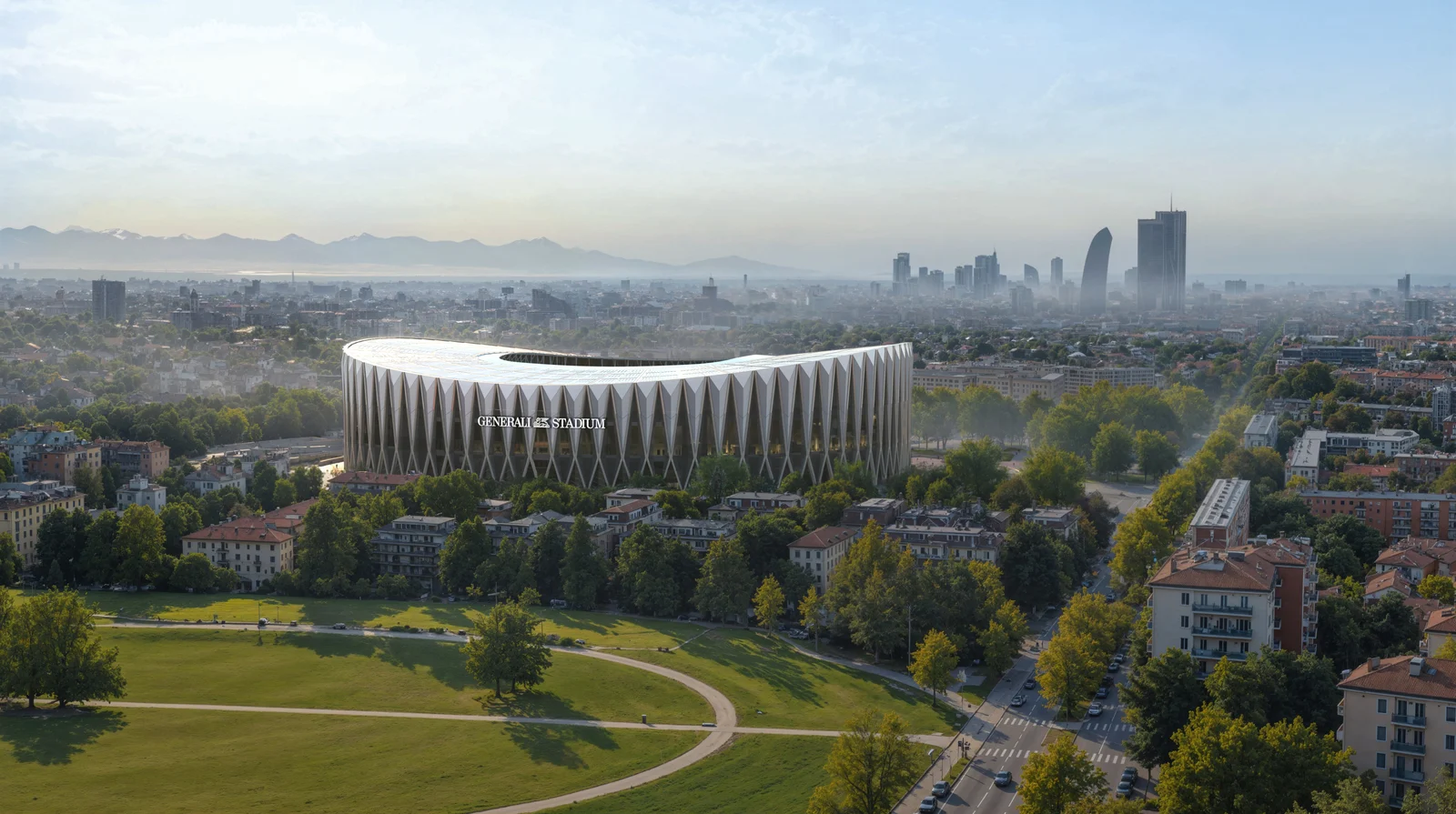
The most revealing part of Milan and Inter’s new stadium unveiling was the name. When the clubs presented their future home on 29 October, Generali was already attached to it. Years before the first match, a major commercial partner had committed to the project. Securing that relationship alongside the design announcement is exactly how an ambitious stadium development should begin.[3–4]
RedBird’s next announcement explained the wider ambition. On 13 November, AC Milan’s owner launched Milan Sports & Entertainment, a holding company intended to bring together its investments across the city’s sports, venues and entertainment businesses, with Brett Yormark appointed chief executive. The Financial Times reports that the structure is being designed with a possible future stock-market listing in mind.[1,10]
The stadium is the strongest foundation for that strategy. Football supplies the audience, identity and regular occasions that bring people together. A well-run venue and the businesses around it can turn those advantages into income throughout the year, reaching customers and commercial partners far beyond the fixture list.
A stadium that works between matches
The proposed 71,500-seat Generali Stadium, shared with Inter, sits within a wider 281,000-square-metre regeneration scheme. The clubs envisage public spaces, retail, leisure and a destination active throughout the year. Construction is expected to begin in 2028, with the first match targeted for 2031/32, subject to approvals.[3]
That is a meaningful change in the economic possibilities of the site. Premium hospitality can earn more from existing demand. Restaurants, shops, conferences and entertainment can create reasons to visit between matches. Concerts can bring in people with no particular attachment to either club. A 365-day venue does not require a full stadium every evening. It requires enough useful, attractive activities to keep the wider destination earning when football is elsewhere.
There is a sporting benefit to getting this right. A larger commercial base can support investment in the team and facilities without depending entirely on broadcast distributions, qualification bonuses or player sales. Infrastructure can give a club more control over how it grows.
The naming agreement deserves particular credit. Adnkronos reports a value of approximately €650 million over 25 years, equivalent to €26 million a year across the project on that reported basis. The clubs and Generali have announced the partnership without publishing its financial terms.[4–5]
The timing matters beyond the headline figure. Generali can become part of the venue’s identity from its first public presentation, carrying the name through years of coverage and construction. For the developers, an early commercial commitment strengthens the proposition they take to other partners and financiers. The published announcements do not establish when payments begin, but securing the partner at this stage is strong commercial execution.
Smart venues have a practical purpose
PwC’s Global Sports Survey 2026 helps explain why stadium investment is attracting attention. In its venue investment question, 61% of executives considered spending on digital ticketing and payment solutions likely or very likely over the following three years. Nearly half expected investment in on-site entertainment and multi-use spaces.[14]
These are complementary investments. A broader programme creates more visits; connected ticketing, payments and customer services can make those visits easier to manage and more valuable. An operator can use transaction data to improve service, understand demand and build commercial packages around actual customer behaviour. Sponsors can buy activity across a calendar, supported by evidence of engagement.
The opportunity extends to operating costs. Energy controls, maintenance systems and better information about how spaces are used can help a venue run efficiently as its programme expands. Technology earns its place when it improves the experience or the economics. That is the useful meaning of a smart stadium.
PwC also finds that supporters put considerable weight on cleanliness, comfort, safety and affordability. Digital investment works best alongside those essentials. A venue that welcomes people efficiently, serves them well and gives them reasons to return has a stronger basis for growth than one relying on expensive hospitality alone.[14]
Building the business around the club
MSE’s announced plans include a venue-management business covering concessions, merchandising and premium suites, a sports and entertainment destination at San Donato, consideration of an NBA Europe franchise and opportunities in tennis.[1–2] These would give the platform several ways to earn from its operating expertise, although the projects are at different stages.
| Business or asset | Position today | Ownership and financing |
|---|---|---|
| AC Milan | Existing football business anchoring the strategy | RedBird-controlled; €1.2bn acquisition completed in 2022. Acquisition financing was refinanced in January 2026.[13,20] |
| San Siro property | Acquired in November 2025 | Held through Stadio San Siro beneath the clubs’ jointly controlled NSM structure; acquisition supported by bank financing.[6–7] |
| Generali Stadium and district | Announced development, targeting 2031/32 | Shared project with Inter; naming partner secured. Full construction funding and distribution arrangements are not set out in the announcements reviewed.[3–4] |
| Venue-management business | Planned | Proposed operating activities; ownership detail, contracts and capital requirements not disclosed.[1–2] |
| San Donato, basketball and tennis | Development ambitions and opportunities under examination | No completed NBA franchise acquisition or fully financed arena programme established by the launch.[1–2,10] |
| MSE listing | Potential future route | No announced offer, timetable or public shareholder terms.[10] |
There is a coherent business model here. An operator able to sell hospitality, run concessions and serve sponsors across several venues could develop a customer base and capabilities that extend beyond one team’s season. San Donato also has a prospective role beyond the earlier football-stadium proposal. Its commercial value would depend on what is ultimately approved, built and operated there.
A useful listed comparison already exists in Denmark. Parken Sport & Entertainment combines FC Copenhagen with stadium-related property and the Lalandia leisure businesses. Its structure shows how public shareholders can participate in activities beyond the team. Its August 2026 results also illustrate the remaining connection: Lalandia’s growth supported revenue, while disappointing football results continued to affect the wider business.[26–27] That is a practical reference point for MSE’s ambition to build several businesses around a sporting institution.
The ownership detail matters because the stadium is shared. Inter’s disclosures show its subsidiary holding half of NSM Holding alongside Milan’s vehicle, with NSM owning the property company.[6] MSE’s economic interest therefore needs to be assessed through Milan’s participation in the structure. Income from the whole development cannot simply be attributed to RedBird’s platform.
The distinction between club income and the value surrounding ownership is central to SportsGlare’s football-club valuation framework. Owners rarely buy clubs for dependable dividends. Much of the financial opportunity lies in capital appreciation and the businesses ownership makes possible, including venues, hospitality, property and commercial services. Milan offers a particularly clear expression of that approach.
The stock market asks a different question
The stadium strategy can be compelling while an eventual listing still deserves scrutiny. The long histories of Juventus, Ajax and Dortmund give investors reasons to look beyond the brand. Adding Manchester United, Celtic, Lazio and Parken makes the comparison more useful, particularly because it includes companies and periods that have rewarded shareholders.[24]
The starting point matters. From a common date of 10 August 2012, the beginning of Manchester United’s current New York listing, Celtic, Lazio and Parken all show substantial price gains. United is also ahead of its starting price. The warning is therefore about the quality and durability of the investment case, rather than an assumption that every listed club loses money.[24–25]
SportsGlare Data 02
The starting date changes the comparison.
One common starting point: 10 August 2012 = 100. Closing-price index at 16 November 2026.
Source: Yahoo Finance; SportsGlare calculations. Local-currency changes, with provider corporate-action adjustments. Dividends, currency conversion, costs and additional rights-subscription cash excluded. These are price indices, not total shareholder returns.
A broader historical study gives the scepticism firmer grounding. In its June 2025 update, Aegon Asset Management reported that its Pelé football index had returned minus 9% since 1998, against plus 270% for broad European equities, using euro-denominated total returns through May 2025. That is a sector comparison over a defined historical period, rather than a selection of disappointing clubs.[28]
SportsGlare Data 03
Football’s long-term market gap.
What €100 invested in 1998 became by May 2025, using Aegon AM’s reported total-return endpoints.
Pelé football index
€91−9% total returnBroad European equities
€370+270% total returnSame €100 starting investment. A different period and return measure from the individual-club price charts above.
Source: Aegon Asset Management, Pelé Index Update, 2 June 2025. Euro-denominated total returns through May 2025. End values calculated from the reported −9% and +270% cumulative returns. The bars show endpoints, not a reconstructed time series.
Recent accounts show why the distinction persists. Juventus reported a €66 million consolidated loss for 2025/26 and approved an approximately €200 million rights issue in November. Ajax returned to a €2 million net profit, but its operating result before player amortisation and transfer results remained €18.2 million negative.[15–17] A large audience can coexist with narrow profits and further calls on shareholders.
Milan’s own accounts make the point. Its reported revenue reached €494.5 million in 2024/25, with a €3 million profit. In 2025/26, without European competition, revenue fell to €464.6 million and the club reported an approximately €24 million loss.[11–12] A broader venue business could make earnings more resilient, but football will continue to influence demand, spending and capital requirements.
For public investors, the crucial question would be which returns they actually receive. Ownership of a club may create opportunities in surrounding property or hospitality, yet minority shareholders benefit only where those businesses and their cash flows sit within their investment. Any MSE offering would need to explain the assets included, debt, construction commitments, related-party arrangements and how cash is shared between the club, stadium partners and operating companies.
That should sharpen the case for the stadium investment. RedBird is pursuing assets and services with the potential to turn football’s extraordinary audience into a broader, more durable business. Milan and Inter have already executed one part particularly well by bringing Generali into the project at unveiling. Delivering the venue and building a profitable calendar around it would make the larger ambition much more tangible.
Sources
- 1. RedBird, 13 November 2026: MSE launch announcement. Confirms formation, leadership and plans. Company statement syndicated by Business Wire. Read announcement.
- 2. Reuters, 13 November 2026. Independent account distinguishing planned activities from the existing club. Read report.
- 3. AC Milan and Inter, 29 October 2026: stadium unveiling. Capacity, district, development stages and target dates. Read joint announcement.
- 4. Generali: naming-partner announcement. Confirms naming rights and insurance partnership, without publishing value or duration in the text reviewed. Read announcement.
- 5. Adnkronos, 30 October 2026. Reports approximately €650m over 25 years. Read original reporting.
- 6. Inter, Sustainability Report 2025/26, corporate organisation section, printed pp.72–75. Shows Blue StadCo, Red StadCo, NSM Holding and Stadio San Siro ownership chain. Read report.
- 7. Inter and AC Milan, 5 November 2025: property completion statement. Names the acquisition vehicle and Goldman Sachs, J.P. Morgan, Banco BPM and BPER as financing institutions. Read statement.
- 8. Municipality of Milan, 30 September 2025: sale approval. Publishes €197,075,590 price and instalment arrangements. Search-indexed municipal text was available; a direct fetch of the separate completion page was blocked. Municipal sale approval. Subsequent 24 March 2026 municipal planning notice independently identifies the purchaser and November sale.
- 9. Il Sole 24 Ore, 6 November 2025. Reports a €1.2bn investment plan at acquisition. Historical project estimate, not a certified November 2026 construction budget or evidence of financial close. Read report.
- 10. Financial Times, Samuel Agini, 13 November 2026: potential MSE listing. Read through the FT article reprint hosted by RedBird because the direct FT page was inaccessible. FT original; accessible reprint.
- 11. AC Milan, 29 October 2026: approved 2025/26 results. Read statement.
- 12. AC Milan, 5 November 2025: 2024/25 results. Club-reported total revenue includes player-related accounting items, so avoid comparing it directly with a ranking that excludes player disposals. Read statement.
- 13. AC Milan, 30 January 2026: acquisition refinancing. Confirms Comvest-arranged replacement financing and Elliott representatives’ departure. Read statement.
- 14. PwC, Global Sports Survey 2026, ninth edition, printed pp.36–37. The 61% is digital ticketing/payments; the survey separately records 36% for the narrower category of automated climate control and AI maintenance. On-site entertainment/multi-use spaces: 48%. Read report.
- 15. Juventus, 3 November 2026: shareholders’ meeting. Approved accounts and distinguishes €66m consolidated loss from €67.2m company-only loss. Read disclosure.
- 16. Juventus, November 2026: related-party disclosure concerning Exor underwriting. Records the board’s 12 November approval of an approximately €200m rights issue under the €250m authority. This is an approved issue, not €200m already received. Read disclosure.
- 17. Ajax, 25 September 2026: 2025/26 results. Defines the operating measure and distinguishes it from net profit. Read results.
- 18. Borussia Dortmund, Annual Report 2025/26: share-price performance; official share-capital history. Annual report section; capital history.
- 19. ARD/Tagesschau, 13 August 2021. Historical source for Dortmund’s €11 IPO issue price. The article does not use its old market quotation as a current price. Read report.
- 20. AC Milan / RedBird, 31 August 2022: acquisition completion. Confirms completion and €1.2bn announced transaction figure. Club statement; original company release.
- 21. Fininvest, 13 April 2017: closing statement, reproduced by SpazioMilan. Distinguishes the €740m valuation including approximately €220m debt from a further €90m reimbursement to Fininvest. Original issuer-hosted copy not located. Read reproduced statement.
- 22. CAS 2018/A/5808, award of 1 October 2018, paragraphs 9–14 and 153. Primary record of the 10 July 2018 creditor-enforcement change of control. Read award hosted by UEFA.
- 23. Elliott, 10 July 2018: ownership statement. Confirms enforcement and a planned initial €50m equity injection, rather than a conventional purchase price. Read company release, syndicated by Business Wire.
- 24. Yahoo Finance historical market data, retrieved for a 16 November 2026 cut-off. Daily historical Close series for BVB.DE, AJAX.AS, JUVE.MI, MANU, CCP.L, SSL.MI and PARKEN.CO. Complete responses, daily CSV, chart-point CSV, summary CSV and calculation scripts are included in the asset bundle. All queries stop before 17 November 2026 UTC. Example Dortmund data request; United data request. The JSON endpoint was accessible directly; some public historical web pages returned rate limits.
- 25. Manchester United, annual report: New York IPO history. Confirms the 10 August 2012 NYSE listing at $14 per Class A share. The charts do not splice this to the former London listing. Issuer report.
- 26. Parken Sport & Entertainment, corporate structure. Identifies FC Copenhagen, Parken property and Lalandia leisure businesses. Issuer structure.
- 27. Parken, 28 August 2026 half-year statement. Records the contribution from Lalandia and the continuing impact of football performance. Issuer statement.
- 28. Aegon Asset Management, Pelé Index Update, 2 June 2025. Primary source for the minus 9% football and plus 270% European market total-return endpoints since 1998, with data through May 2025. The graphic uses those endpoints; it does not reconstruct an undisclosed annual index series. Read study.
- 29. Official Generali Stadium project website and AC Milan gallery, 29 October 2026. Source and credit for the stadium renderings. Project website; club gallery.
- 30. Celtic, issuer share-capital disclosure. Used to verify the comparison concerns ordinary shares, not its separate convertible preference classes. Yahoo ticker CCP.L identifies the ordinary quotation. Issuer disclosure.