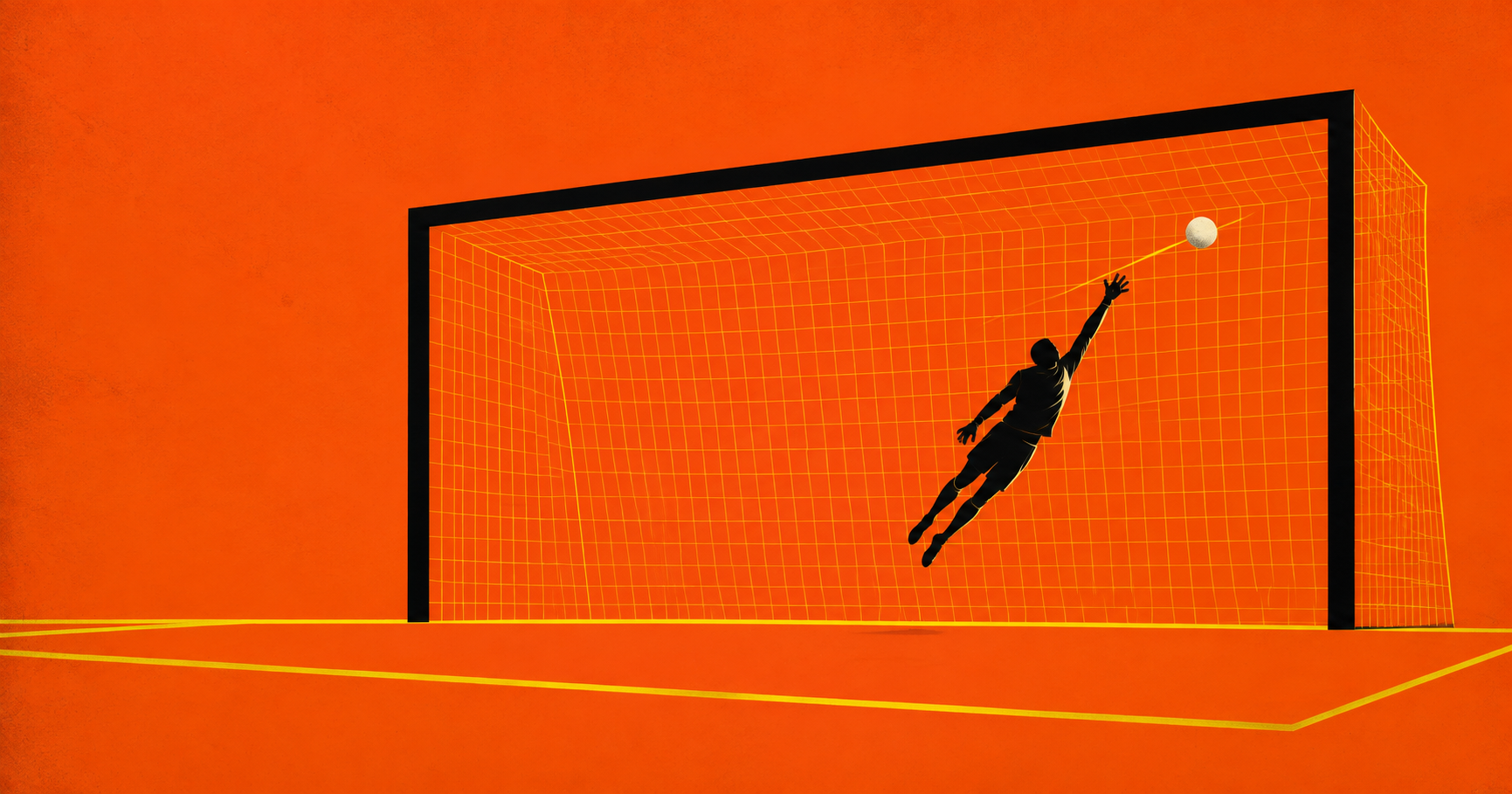
Football has changed almost everything around the goal. The players are taller, fitter and faster. Goalkeepers are better selected, better coached and more athletic. Their positioning is mapped, their movement is analysed and their decision-making is trained. The aperture they defend, however, belongs to the Victorian game.
The goal became eight yards wide in the Football Association’s first laws in 1863. An eight-foot tape was added in 1866, creating the dimensions that still define the target. A rigid crossbar came later, but the aperture itself has now survived for 160 years.
That is not an abstract tradition. It is a piece of sporting geometry that has stood still while the bodies and methods around it have changed. Football should enlarge the goal to 8.5 yards by 8.5 feet.
The game outgrew its Victorian target
The people playing the game are no longer the size of the people for whom those dimensions were written. Research covering young adult men in 15 European countries found that average height rose by about 11 centimetres between the 1870s and the late twentieth century. The Dutch increase since the nineteenth century was around 20 centimetres. The physical scale of the game changed. The target did not.
Goalkeepers show the same direction more sharply. A 2022 paper by César A. Morales selected one goalkeeper from every country at the 1930, 1958 and 2018 World Cups. Their reported average heights were 177.1 centimetres, 182.3 centimetres and 189.4 centimetres. The 2018 figure was 12.3 centimetres, or 6.9%, above the 1930 average.
SportsGlare’s calculation from FIFA’s official 2026 squad list moves the number on again. All 145 listed goalkeepers averaged 189.8 centimetres. Taking the number-one shirt from each of the 48 teams as a consistent one-per-country comparison produces an average of 190.0 centimetres. That is 12.9 centimetres, or 7.3%, above Morales’s 1930 benchmark.
Height is only the beginning. Modern goalkeepers add specialist coaching, explosive push-off, longer effective reach, sharper anticipation, optimised starting positions and detailed opponent analysis. The defender of the goal has evolved in every relevant dimension. The goal itself has evolved in none.
A high-scoring World Cup made the business case visible
The 2026 World Cup gave football a timely glimpse of a more eventful scoring environment. Its group stage produced 215 goals in 72 matches, or 2.99 per game, the highest group-stage rate since 1958. Across the expanded tournament, 308 goals were scored in 104 matches, a record total. The greater spread in team strength helped generate goals, but it also showed how much energy repeated attacking moments can pour into a competition.
FIFA reported 29 billion video views across its World Cup platforms by the end of the competition. Goals sit at the centre of that content economy. They are football’s clearest self-contained stories, but the moments around them matter too: the near miss, the spectacular foul, the fingertip save, the lead change and the comeback.
In background discussions for this article, specialists working across football technology, media and rights repeatedly described those events as the game’s most valuable short-form raw material. Their view is simple: more meaningful action is good for the match and good for the business around it.
Audience behaviour reinforces the point. A Divrse Media survey found that 59% of its Gen Z football respondents watched short-form highlights. A PwC survey of about 2,000 US sports fans found that only 19% of 18-to-34-year-olds watched an entire game when viewing at home, while nearly 70% used social media during play. Football is now consumed as a live contest and as a stream of moments. A better supply of moments serves both.
More goals are not the only route to excitement, but they are the game’s most valuable events. A modestly larger goal would increase the likelihood that pressure, invention and high-quality shooting receive a visible reward.
Half a yard wider. Half a foot higher.
The current goal is 24 feet wide and eight feet high, giving an opening of 192 square feet, or 17.837 square metres. An 8.5-yard by 8.5-foot frame preserves the familiar 3:1 proportions. It adds nine inches on each side, six inches above the crossbar and 12.891% to the total area.
| Frame | Imperial dimensions | Metric dimensions | Area | Area change |
|---|---|---|---|---|
| Current | 8 yd × 8 ft | 7.315 m × 2.438 m | 17.837 m² | Baseline |
| Bigger goal | 8.5 yd × 8.5 ft | 7.772 m × 2.591 m | 20.137 m² | +12.891% |
Why 8.5 works: Width and height each rise by 6.25%, close to the 7.3% increase between Morales’s 1930 goalkeeper average and SportsGlare’s 2026 number-one average. The familiar shape remains; part of the physical change in the players is given back to the attack.
That is a meaningful change, but not a reinvention of football. The goal would look familiar from every seat and on every screen. The extra space sits exactly where modern reach and positioning have made the target hardest to beat: beyond the dive and above the hand.
More goals keep more matches alive
Football’s low scoring is part of its power. A single goal can transform the meaning of every remaining minute. But extreme scarcity has a cost. Once a side controls a one-goal lead, too many matches become exercises in protecting one decisive event.
A moderate rise in conversion creates more routes back. A trailing team has a better chance to equalise, then to turn the match around. A 2-0 scoreline is less final in a game with more credible scoring opportunities. Leads remain valuable, but they become harder to sit on.
That produces more live scorelines, more lead changes and more minutes in which both teams have something realistic to chase. It rewards ambitious play and gives the live audience, broadcasters, sponsors and social platforms more moments of consequence.
The aim is not basketball scoring. It is a disciplined rebalancing. Half a yard of width and half a foot of height is enough to make elite finishing count more often without changing the identity of the sport.
The cost of change is manageable
A larger frame would require new goals, nets and anchors, together with updates to goal-line technology, VAR geometry and broadcast graphics. Those are real tasks, but football already replaces certified equipment and updates technical systems on competition cycles.
The FIFA Quality Programme already provides the framework for goal safety, durability and performance. Manufacturers can engineer and certify the new dimensions. Competitions can phase them in over a defined implementation window, aligned with stadium works and equipment replacement.
Football has absorbed far more complicated changes. Video review rewired officiating. Goal-line technology placed cameras and sensors around the target. Expanded tournaments altered calendars, travel and formats. Moving each post nine inches and the crossbar six inches is an implementation project, not an existential threat.
Change the target
The goal feels sacred because it frames football’s defining moment. Its exact dimensions are not sacred. They were fixed before nets, penalty areas, substitutes, professional goalkeeping, sports science, broadcast television and the global highlight economy.
Football has rewritten the pass-back rule, introduced goal-line technology, added video review and expanded substitution. Each change answered the game that football had become. The goal deserves the same treatment.
An 8.5-yard by 8.5-foot frame matches the scale of the modern athlete, rewards attacking quality and creates more of the moments on which football’s sporting and commercial appeal depend. It is bold enough to matter and modest enough to remain unmistakably football.
Footballers grew. The goal did not. Now it should.
Sources
- IFAB, Law 1: The Field of Play
- Football Association, Laws of the Game (1863)
- Football Association, Laws of the Game (1866)
- Hatton and Bray (2010), Long run trends in the heights of European men
- Stulp, Bonnell and Barrett (2023), Simulating the evolution of height in the Netherlands
- César A. Morales (2022), Goalkeeper height increase over 90 years
- FIFA, official FIFA World Cup 2026 squad lists
- FIFA, How all 308 World Cup 2026 goals were scored
- Data Explained/StatsBomb, 2026 group-stage scoring
- FIFA, World Cup 2026 by the numbers
- PwC (2024), Engaging younger sports fans
- Divrse Media, The Gen Z Football Report
- FIFA Quality Programme for Football Goals