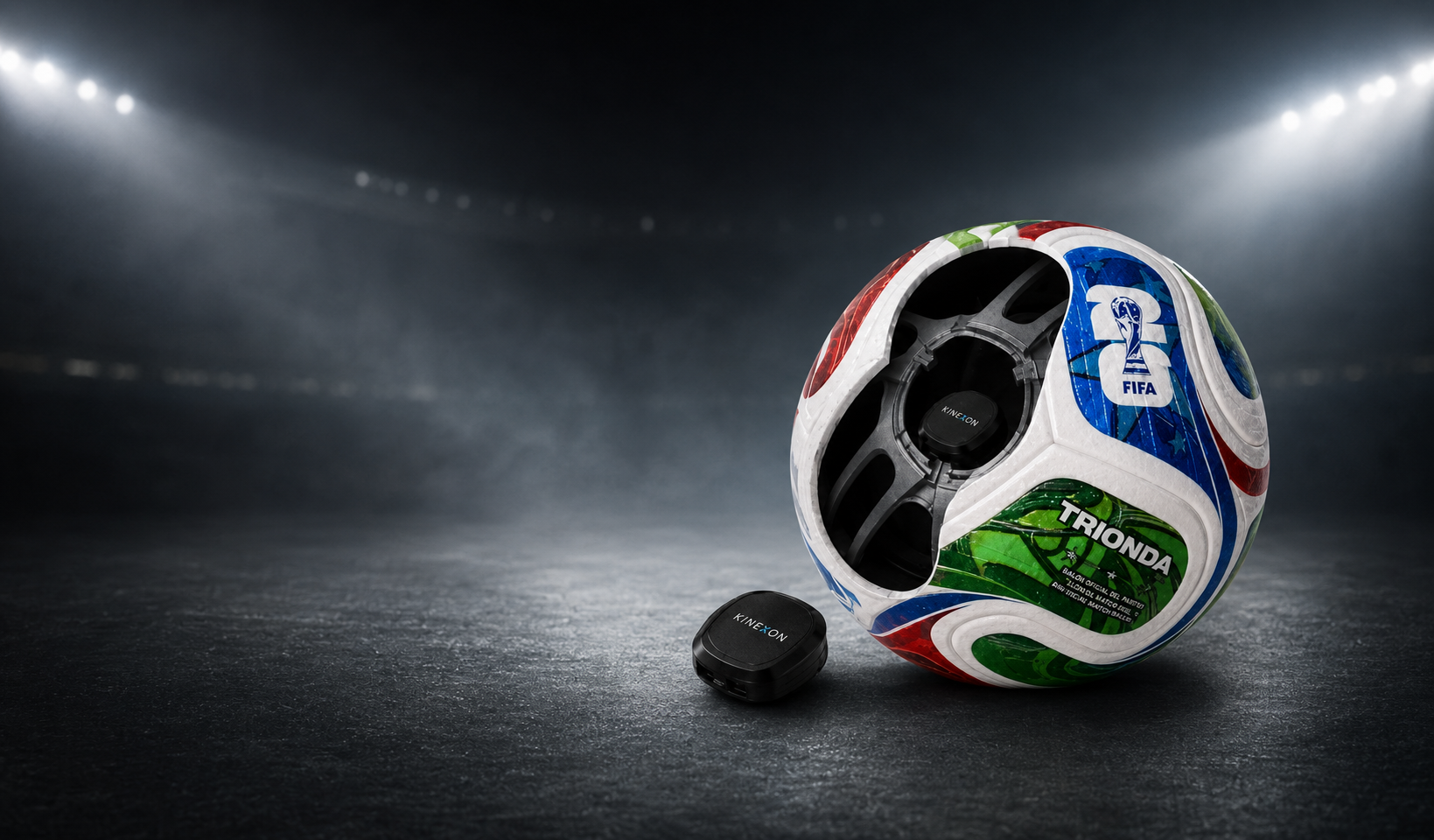
A football can now tell officials when it was touched, coaches how it was struck and broadcasters how fast it travelled. Kinexon Sports has built the system behind that promise: a sensor inside the ball, radio equipment around the stadium, player-tracking technology and software that turns the signal into decisions, analysis and television graphics.
SportsGlare understands that Kinexon Sports is being prepared for a full sale.
It is a specialist business within the wider Kinexon group, which also supplies real-time location and automation systems to industrial customers. Its football operation is best known for the connected-ball infrastructure used in elite competition, but it also sells player tracking, performance software and data products to clubs, leagues and broadcasters.
That makes it one of sport technology's more unusual assets. The same product that gives Kinexon a powerful claim to precision also requires costly physical infrastructure, specialist operations and a clear answer to a more basic question: does the extra data materially improve the game for the people who pay for it?
The commercial case
People familiar with the business say Kinexon Sports had annual recurring revenue of about US$12 million at the end of 2025 and is targeting roughly US$17 million in 2026. The business is not yet EBITDA-positive, they say, with break-even forecast for this year and a longer-term plan for material margin expansion.
Those figures are management information, not audited public accounts. They point to a business that is still being valued on future operating leverage rather than current cash generation.
The quality of the revenue is part of the attraction. SportsGlare understands that around 88 per cent of expected 2026 revenue is recurring, while league and federation agreements can run for four to five years. Their total contract values are typically between US$2 million and US$8 million.
That last number needs care. It is contract value over a multi-year term, not an annual cheque. A US$2 million to US$8 million agreement spread across four to five years is closer to US$0.4 million to US$2 million of annual revenue before Kinexon carries the cost of equipment, installation, support, ball logistics and customer success.
The top end is strategically attractive, but these are not ordinary software sales. Large contracts can take up to 24 months to close. Clubs account for the majority of revenue, while a smaller number of leagues and federations provide the potentially transformative contracts.
LaLiga's 2026/27 deployment is the clearest public illustration of the opportunity. The Spanish top flight has installed Kinexon technology in every stadium and uses a Puma ball with an embedded sensor across every match. It is the first national professional football competition to roll out connected-ball technology across its full schedule, according to LaLiga.
The rollout matters because it moves the technology beyond a showcase tournament. It should not be described as the first non-adidas connected-ball deployment, however. Liga Portugal used Kinexon technology in a Derbystar/SELECT iBall project in 2022. LaLiga is important because of its full-season, league-wide scale and because the Puma integration shows that the system is not confined to an adidas ball.
The ball is only the visible part
Calling this a football with a chip inside it understates both the product and the cost.
The ball carries an inertial measurement sensor. Kinexon's architecture combines that with ultra-wideband radio and a local positioning system around the pitch. Optical tracking, calibrated pitch geometry and software then give the motion data context. The system can identify a precise touch point, help establish the moment an offside phase begins, produce coaching information and generate data for broadcasts or digital products.
But the sensor is not a standalone service. The operational system includes purpose-built match balls, receivers and antennas, charging, calibration, signal testing, data transmission, integration with match operations and people trained to run it.
LaLiga is unusually candid about that operational layer. It says it has installed about 12 antennas in each stadium and uses 14 connected balls per match. Each ball must be identified, charged, checked and validated before kick-off. The balls are excluded from warm-ups and training, while the competition has protocols for custody, signal verification and technical incidents.
This is evidence that Kinexon can scale. It is also evidence that the scale is expensive and operationally demanding. The company is not merely selling another analytics seat. It is installing an on-site system and supporting it in every venue, every week.
SportsGlare understands from a client with direct knowledge of one deployment that an official adidas connected match ball costs roughly EUR2,000 before the positioning, service and operating infrastructure is considered. This is not a retail price and should not be treated as a standard tariff. In LaLiga, a league executive told Cadena SER that the sensor added about EUR160 to the cost of its Puma ball. The supply arrangements are different, so the two figures are not directly comparable. Together they underline the same point: the ball price is only one line in the bill.
That creates a genuine moat. Once a league has fitted its stadiums, integrated the data into referee and broadcast workflows, trained staff and created protocols around the balls, switching supplier is much harder than cancelling a dashboard subscription.
It also limits the addressable market. The model is most compelling for centrally organised, well-funded elite competitions. It is much less obviously economic for the many clubs, leagues and federations that want useful tracking data without a permanent hardware project.
A premium system has to prove its value
Kinexon sells the ball's output across three uses: officiating, performance and fan engagement. The first has a clear decision-making function. The latter two are more difficult to price.
For a club, precise player and ball information can help with load management, training design and analysis. For a broadcaster, live speed, spin and touch information can produce new graphics. For a league, the product promises an upgraded feed for media partners and sponsors.
None of that automatically proves that a US$2 million to US$8 million league deal creates equivalent value. There is no public independent evidence that fans will pay more for connected-ball data, that it sustains broadcast audiences or that it reliably produces new rights or sponsor revenue.
Kinexon's own Liga Portugal case study says that 80 per cent of spectators asked after two 2022 playoff matches wanted the visual statistics used at more matches. It is encouraging, but it is a limited survey reported in a supplier case study, not proof of durable audience demand at the cost of a league-wide installation.
The real test is not whether viewers enjoy a spin-rate graphic once. It is whether a rights holder can monetise it enough to justify the hardware, service and operational burden for years.
The same question applies to fairness. A system can be more accurate in a technical sense while making the sport feel less fair to its audience.
At the World Cup, Croatia's apparent late equaliser against Portugal was disallowed after the connected ball detected a slight contact by Igor Matanović. The touch was not apparent in ordinary replays, but it changed the offside sequence and therefore the result. FIFA said the technology had established the contact. Croatia challenged the wider officiating process afterwards.
For advocates, this is the product working exactly as intended: an otherwise invisible touch becomes measurable, and the law is applied accurately. For critics, it is a warning that an imperceptible action which did not visibly change the ball's path can decide a major match because a sensor, rather than the available pictures, says it occurred. The technology may be correct and still leave supporters feeling that the game has become less legible.
The Norway case is a test of trust, not a settled fact
The World Cup quarter-final between England and Norway raised the opposite concern. Norway argued that a goal kick had struck an overhead spidercam cable before the move that led to England's equaliser. FIFA said the connected-ball signal showed no peak in the ball's movement data and therefore no evidence of contact.
An independent frame-by-frame study by University of Western Australia Associate Professor Ronnie Das reached the same broad conclusion from the broadcast footage: it found no detectable impact and a flight consistent with ordinary aerodynamics.
That does not entirely close the argument in public. A competing explanation still advanced by some critics was that the ball could have travelled beyond reliable receiving coverage, leaving the system unable to record contact. There is no published evidence that this happened. FIFA did not release the full raw telemetry, so the public cannot establish whether the trace was continuous or whether a coverage gap existed. Das's analysis tests the footage, not the radio coverage.
The proper conclusion is not that the ball failed. The available public evidence supports FIFA's call. The episode instead shows why such systems must be transparent when they decide or explain a major moment. A league buying a high-cost officiating tool is also buying the responsibility to show supporters why it should be trusted.
The camera question
The expensive hardware is not Kinexon's only way to gather sporting data. The company itself sells a computer-vision product, COMPETE Vision, which analyses uploaded video without player wearables. That is a sensible extension into customers who do not need real-time, centimetre-level positioning.
It is also a reminder of the strategic risk. Camera systems and image models are improving rapidly, are easier to deploy and do not require a sensor embedded in every match ball or receivers around every stadium. They cannot necessarily replicate the connected ball's exact, instantaneous measurement of an otherwise invisible touch. That is Kinexon's edge today.
But a buyer has to ask how much precision customers will pay a premium for as vision models become good enough for more coaching, broadcast and analytical use cases. If cameras can deliver most of the commercial value without permanent venue hardware, connected-ball infrastructure risks becoming a costly answer to a narrowing set of ultra-precise officiating problems.
The same issue reaches the next European match-ball cycle. Nike has secured the official-ball rights for UEFA's men's club competitions from 2027 to 2031, replacing adidas after the 2026/27 season. There is still no public indication that Nike's Champions League ball will carry Kinexon technology. Puma's LaLiga ball shows the integration is technically possible outside adidas. Whether Nike, UEFA, the competition's VAR operation and a data provider choose to fund and operate it is a separate commercial decision.
A portfolio bet on the sport, not a bet on a team
This is also why sports-technology assets can attract a different sort of investor from a football club. Club ownership is usually an asset-appreciation story with intense single-club exposure. Performance on the pitch, qualification for European competition, a single transfer window or relegation can have an outsized effect on value.
Kinexon's exposure is different. It can grow with the professionalisation of sport, the demand for data and the rising technical requirements of leagues, while spreading customer exposure across clubs, leagues, federations, broadcasters and different sports. One team's season does not determine the investment outcome.
That does not make the model safe. Customer concentration, adoption cycles, hardware costs and technology substitution are all material risks. But it gives an investor a portfolio of sports-industry customers rather than a direct bet on one set of results. It is the other side of the equation set out in SportsGlare's guide to how investors value football clubs: participate in sport's growth without carrying the full sporting risk of owning a club.
What is actually for sale
The sale is not a simple bet on a clever sensor. It is a bet that Kinexon's physical layer, data products, client relationships and league-level operating capability can be separated cleanly from the wider group and turned into a profitable specialist platform.
No public valuation has emerged for the sports operation. People familiar with the process and with sports-technology transactions put forward an enterprise-value case of around US$150 million, although SportsGlare has not seen formal price guidance. On roughly US$17 million of 2026 ARR, that would equate to about 8.5x to 9.0x ARR.
That is below the 12x to 15x ARR and roughly 20x to 30x EBITDA multiples that people in the sector say can attach to highly profitable, high-quality sports-technology businesses, with 25x as a useful midpoint. It is still a demanding valuation for a company that has yet to reach profitability. The rationale is that the buyer would be valuing the 2026 exit run-rate, the LaLiga proof point and the possibility that the physical infrastructure becomes a scalable platform, rather than simply a hardware-heavy supplier.
A buyer will have to balance rare, high-profile deployments, recurring contracts and differentiated sensor capability against current losses, slow procurement, hardware and service intensity, data-rights constraints, potential customer concentration and the risk that computer vision erodes part of the advantage.
Kinexon has proved that a football can become a live source of data. The sale process will test whether that makes the company a rare data platform, or an excellent but operationally demanding piece of elite-sport infrastructure.
Sources
Public sources
- LaLiga: Connected Ball deployment across all top-flight matches
- FIFA: launch of the 2026 World Cup TRIONDA match ball
- Kinexon: FIFA Preferred Provider for Live Player and Ball Tracking
- Kinexon: Liga Portugal connected-ball case study
- Kinexon: computer vision tracking product
- University of Western Australia: independent analysis of the England v Norway cable incident
- The Guardian: Norway's cable claim and FIFA's connected-ball response
- ITV News: Croatia v Portugal and the connected-ball decision
- LaLiga ball cost, charging and stadium infrastructure, Cadena SER
- UEFA: adidas remains Champions League ball supplier through 2027
- The Guardian: Nike's confirmed UEFA men's club competition match-ball rights award
- UEFA Champions League regulations 2026/27, Article 50