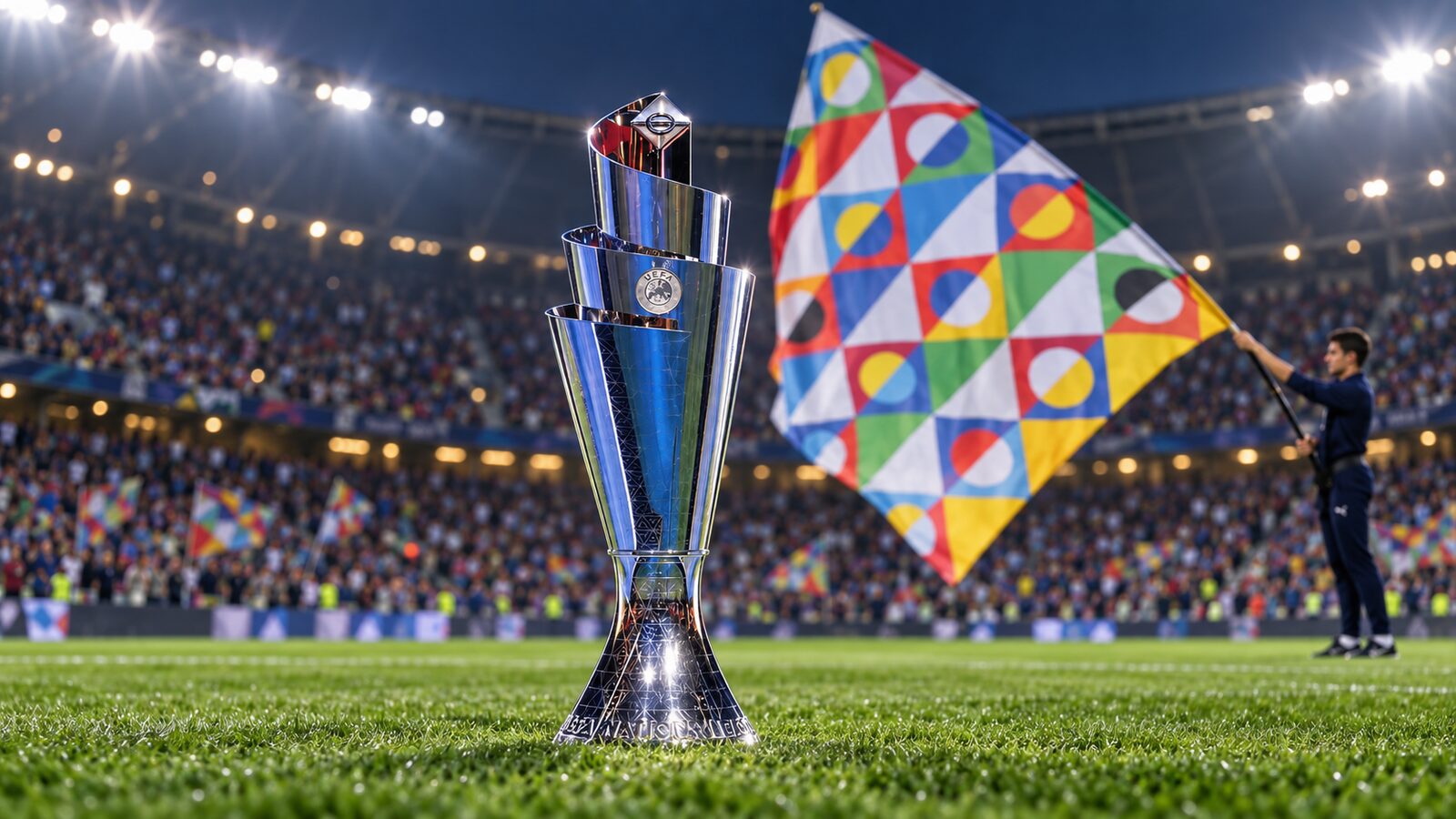
2026/27 is a sorting season
UEFA is changing the Nations League, but the change does not start with a new three-league competition this month.
The 2026/27 league phase still uses the existing pyramid. Leagues A, B and C each contain 16 teams. League D contains six. The four-team groups remain in the top three divisions, and League D still has its two groups of three.
What UEFA approved on 15 September was the mechanism for dismantling that structure afterwards.
The promotion and relegation rules have been adjusted so that the competition can emerge in 2028/29 with two 18-team upper divisions and a rebuilt League C. In effect, UEFA has designed the 2026/27 movement between leagues backwards from the structure it wants to create next.
2026/27
and play-offs→
2028/29
The four League B group winners move directly into the future League A. Four further League A places are decided through promotion/relegation play-offs involving League A and League B sides. At the other end, the lowest-ranked League A teams either enter those play-offs or drop directly.
League B is rebuilt in much the same way. League C group winners move up automatically, with further places settled through B/C play-offs. League D then disappears, with its six teams absorbed into the new League C.
The 2026/27 transition
| 2026/27 finish | Outcome |
|---|---|
| League A group winners and runners-up | Quarter-finals and remain in future League A |
| Best two League A third-placed teams | Remain in League A |
| Other two League A third-placed teams | A/B play-off |
| Best two League A fourth-placed teams | A/B play-off |
| Other two League A fourth-placed teams | Relegated to League B |
| League B group winners | Promoted to League A |
| League B runners-up | A/B play-off |
| League B third-placed teams | Remain in League B |
| League B fourth-placed teams | B/C play-off |
| League C group winners | Promoted to League B |
| League C runners-up | B/C play-off |
| League C third- and fourth-placed teams | Enter the new League C |
| League D teams | Enter the new League C |
The 2026/27 results populate the new three-league structure from 2028/29.
The simplest way to read 2026/27 is therefore as a bridge. The old competition still plays out, but its results are being used to populate a different one.
Six matches, five opponents
The more interesting structural change begins in 2028/29.
UEFA will move from four leagues to three. The base design is 18 teams in each league, divided into three groups of six. If all 55 UEFA associations participate, League C will instead contain 19 teams, with one seven-team group whose calendar starts one window earlier.
A normal six-team group would require ten matches if every team played every opponent home and away. UEFA does not want ten matches and does not have the international dates for them. Each country will therefore still play only six Nations League games.
The difference is who those six games are against.
Each team will play one opponent from its own seeding pot twice, home and away. It will face the four teams drawn from the other pots once each, either home or away.
Current format
6 matches → 3 opponentsFrom 2028/29
6 matches → 5 opponentsThe current structure produces six matches against three opponents. The new one produces six matches against five.
That is the commercial logic hidden inside what otherwise looks like a competition-format adjustment.
The Nations League originally turned friendly dates into competitive inventory. Its next problem is repetition. Six matchdays against the same three countries can leave an association with an unappealing draw defining almost its entire autumn.
The new structure creates more combinations from the same number of dates. UEFA itself says the changes are intended to improve competitive balance, reduce dead matches and increase the value of its men’s national-team football.
It does not guarantee better football. League A becomes slightly wider, and four of the five opponents will no longer be played both home and away. The schedule is less symmetrical.
But it gives UEFA considerably more variety without demanding another international window.
The Nations League is becoming more important as well
The 2028 reform goes beyond the Nations League.
UEFA is also redesigning European qualification around Nations League position. The 36 countries occupying Leagues A and B will form the first tier of the new European Qualifiers. The remaining 18 or 19 countries will sit in a second tier.
That makes the Nations League part of the architecture of World Cup and European Championship qualification rather than a competition sitting alongside it.
This matters when considering what could come next, because combining the UEFA and Concacaf Nations Leagues would not simply mean finding new opponents. Both confederations already use their Nations Leagues to support other competitions.
Concacaf has the opposite problem
Concacaf’s Nations League performs a valuable role for smaller associations by guaranteeing competitive fixtures at an appropriate level. Its biggest countries face a different issue.
For 2026/27, Mexico, the United States, Canada and Panama bypass the League A group stage altogether. They enter directly in the quarter-finals in November. The other 12 League A teams play through September and October.
That leaves four of the confederation’s most commercially valuable national teams needing to fill significant parts of their autumn calendar elsewhere.
Before UEFA created the Nations League, European national teams were obvious friendly opponents. UEFA has since filled those windows with competitive fixtures of its own.
A combined competition offers a way to reopen that inventory, but with competitive meaning attached.
A United States versus England, Mexico versus Spain or Canada versus France fixture is a materially different commercial product when it sits inside a competition rather than being assembled as another friendly.
That helps explain why the UEFA-Concacaf discussions matter beyond novelty.
What is actually being discussed
There is now enough reporting to describe the direction of travel, but not a finished competition. The Guardian first reported in August that UEFA and Concacaf were discussing a combined Nations League involving all 96 associations, and ESPN subsequently reported the talks independently. The important point is scale. This is not a proposal to add a handful of North American sides to a European tournament. It is a discussion about whether two existing national-team systems could be reorganised around one shared property.
The reported framework is broad but coherent: several leagues, a genuinely shared top level, geographical scheduling during the autumn, knockouts in March and a Final Four in June. Mexico, the United States and Canada are the obvious Concacaf countries for an integrated elite division. Pooling at least part of the commercial revenue has also been discussed, which matters because the case for smaller associations depends on more than getting an occasional high-profile fixture.
What remains open is the machinery that would decide whether the idea is workable. No league sizes, groups, promotion places, transatlantic-match minimums or qualification links have been announced. Those details are not administrative footnotes. They determine whether the competition is a common sporting ladder, a set of regional schedules with a shared showcase, or something in between.
What has been reported96 associations · multiple leagues · geographical scheduling · March knockouts · June Final Four
What has not been announcedLeague sizes · group sizes · promotion places · transatlantic matches · qualification links
Integrated League A, regional lower tiers
Closest to the reported concept. The strongest sides share an elite division while lower tiers are protected by geography.
Fully integrated 96-team pyramid
SportsGlare model. One promotion-and-relegation ladder, with geographical scheduling used to limit travel.
Regional league phases, shared knockouts
SportsGlare alternative. More regional autumn play, with the strongest teams routed into a joint knockout stage.
The shape of a combined league
The most plausible version starts with a shared League A and regional protection below it. That would put the fixtures with the clearest audience and sponsorship value, such as the United States against England or Mexico against Spain, inside a meaningful competition while avoiding the absurdity of routinely sending smaller Caribbean and European associations across the Atlantic. It is also closest to the framework that has been reported.
That compromise has a sporting cost. A completely open promotion-and-relegation system could soon leave the top tier overwhelmingly European. Protecting a number of Concacaf places would preserve the commercial premise but make the ladder less purely merit-based. A fully integrated 96-team pyramid is tidier on paper, yet harder to operate and difficult to square with the three-league UEFA structure that will only just have begun. The third route, mostly regional league play feeding into a shared knockout stage, is easier to schedule but offers fewer of the transatlantic fixtures that make the merger interesting in the first place.
The negotiations therefore are unlikely to turn on whether Europe and North America can play more matches. They will turn on how much sporting symmetry each side is prepared to trade for a competition that works commercially, geographically and politically across two confederations.
The contracts and qualification problem
That calculation starts with rights already sold and qualification systems already built. Concacaf has scheduled a 2028/29 Nations League under its current three-league model, the same cycle in which a combined competition could begin. Its U.S. English-language deal with FOX Sports runs through 2029 and explicitly includes that season; the Spanish-language agreement with TelevisaUnivision does too. A revised property is not impossible, but a competitive USA-England match would be a materially different product from the inventory those contracts originally described.
Qualification may be even harder. Concacaf still uses the Nations League as a Gold Cup pathway, while UEFA is tying Nations League position into the new European Qualifiers. A common ladder would therefore need to answer two different questions at once: who an association plays in the autumn, and what that result means inside its own confederation’s route to major tournaments. Separate regional qualification calculations can coexist with a shared competition, but they must be designed deliberately rather than bolted on after the rights package is announced.
That is why combining the Nations Leagues is a governance and commercial exercise, not a fixture-list exercise. The teams are the visible part of the proposition. The durable value sits in the agreements underneath it: promotion rules, qualification access, revenue distribution and the definition of the rights property itself.
Why 2028 matters
UEFA does not need Concacaf to justify its own reform. Moving from four leagues to three creates more opponent variety without adding an international window, while helping embed the Nations League more deeply in European qualification. Concacaf, meanwhile, has leading teams with meaningful autumn gaps and a North American market that UEFA cannot reach regularly through its existing calendar.
What gives the current discussions weight is the coincidence of those decisions. UEFA’s new structure begins in 2028/29. Concacaf has another Nations League planned for the same cycle. The earliest reported start for a combined competition is autumn 2028, and the confederations’ April 2026 cooperation agreement runs until 2031 and allows further joint initiatives by mutual agreement.
None of that proves UEFA designed its format around Concacaf. It does show that both sides are rebuilding national-team inventory at the same moment, with a new commercial opportunity sitting between them. By 2028, the question will not be whether Europe and North America can arrange more attractive friendlies. It will be whether they are prepared to combine enough of their national-team business to make those fixtures part of a lasting competition.
Sources
Primary sources
- UEFA, 15 September 2026: New promotion/relegation system for UEFA Nations League 2026/27
- UEFA, 20 May 2026: New concept for men’s national-team competitions from 2028
- UEFA and Concacaf, 29 April 2026: Memorandum of Understanding
- Concacaf: 2026 to 2030 men’s senior national-team calendar
- Concacaf and FOX Sports, 24 June 2026: U.S. English-language rights
- Concacaf and TelevisaUnivision, 14 May 2026: U.S. Spanish-language rights