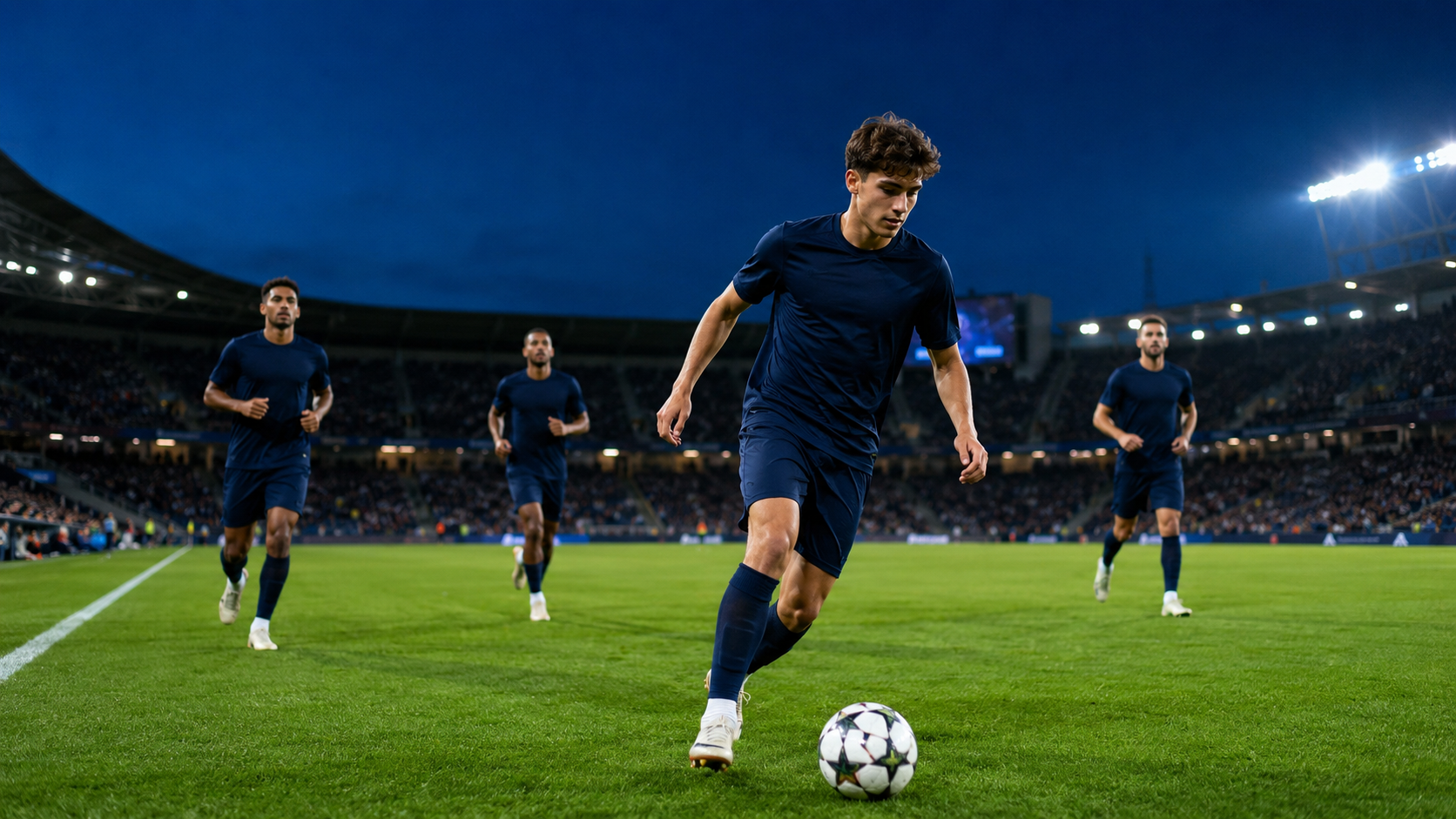
In March 2025, Oscar Bobb played an hour for Manchester City’s Elite Development Squad against Crystal Palace. It was his first competitive appearance after more than seven months out with a serious leg injury.
Alongside him was Vitor Reis, another member of Pep Guardiola’s first-team squad. City’s development coach, Ben Wilkinson, said Bobb needed minutes to regain trust in his body, while Reis’s quality and professionalism would rub off on the younger players around him.
That one team-sheet contained almost everything needed to sell a football match.
There was a recognisable player beginning a comeback, another senior professional needing game time, young prospects testing themselves beside them and a direct connection to the first team that supporters pay to watch. One player was trying to return. Another was trying to be ready. Several others were trying to be next.
Yet this was treated chiefly as a development update. Football had the players and the plot, but not the product.
That is the opportunity. The biggest clubs in Europe already employ the talent, own the grounds, operate the media channels, hold the supporter data and produce the content. What they lack is a competition designed to turn all of it into a regular commercial property.
Let supporters know them before they become stars
Academy graduates create a different kind of attachment. A transfer can become a favourite. A player who has grown up at the club can feel like part of the club itself.
Dani Carvajal is the perfect example. He joined Real Madrid at ten. Two years later, on 12 May 2004, he laid the first stone of Real Madrid City alongside Alfredo Di Stéfano. Twenty years later, he scored the opening goal in the Champions League final at Wembley and was named player of the match as Madrid won its 15th European Cup.
When Carvajal left the club in 2026, the Bernabéu displayed that childhood image again. The message across the stand was: “The dream of a child, the triumph of a legend.”
Football usually tells that story retrospectively, once the boy has become a legend. A proper weekly competition would let supporters live it. They could first watch the 17-year-old against Barcelona, recognise him on the senior bench, celebrate his debut and feel that his first major goal completes a journey they have followed for years.
That is not sentimental decoration around the product. It is the product. Every first-team promotion becomes a narrative payoff. Every academy graduate who succeeds increases the value of the matches that showed where he came from. The competition creates recognition before fame, then carries that emotional investment into the premium first-team game.
Two models, neither yet a product
Europe already offers two competing ideas for the final stage before first-team football.
England separates its leading academies. Premier League 2 has 31 clubs in 2026/27, playing 20 regular-season matches in one combined table before a 16-team knockout phase. The Premier League says the format is designed around development and flexibility. That is reasonable for coaches. It is less useful for anyone trying to build appointment viewing. The schedule is unbalanced, relegation has disappeared and senior-player involvement is possible but commercially unpredictable.
The Netherlands does the opposite. Jong Ajax, Jong PSV, Jong AZ and Jong Utrecht play in the professional second tier against adult first teams. The sporting logic is strong. Young players meet experienced opponents, hostile away crowds and clubs for whom the result affects jobs, promotion and survival.
The KNVB’s own case for reserve teams in the pyramid is built around that greater resistance. It also cites older evidence that Jong Ajax attracted up to 27 per cent more spectators when visiting other clubs and that matches involving Jong Ajax drew television audiences 57 per cent above the division’s average. A famous academy can be an attractive away team.
But that has not made the reserve sides attractive home properties.
In the 2025/26 Eerste Divisie, the four Jong teams were the four lowest-attended teams in the competition. Jong Ajax averaged 1,213, Jong PSV 931, Jong AZ 545 and Jong Utrecht 488. Together they averaged 794 spectators. The other 16 clubs averaged just over 7,050.
That is not a small gap. The reserve teams drew roughly one-ninth of the home crowds generated by the adult clubs around them.
There are explanations. Jong teams often play at smaller grounds, on Mondays and without the same promotion rights or stable line-ups. Those explanations are also the commercial problem. Adult opposition does not automatically transfer adult meaning to a reserve side. Supporters of the parent club still know that Ajax against Jong PSV is not Ajax against PSV. Supporters of the other clubs know the Jong teams cannot be promoted and may field a materially different side from one week to the next.
The Dutch model is a good laboratory. It is not evidence that integration creates a valuable new media property.
The commercial answer is therefore a separate competition. But it cannot simply reproduce Premier League 2 with better graphics. It needs the competitive seriousness of the Dutch pyramid, the club identity of a standalone competition and a compulsory connection to the first team.
Build the league around three senior players
The simplest rule is eight plus three. Eight starters must be 21 or younger. The other three positions are open age.
Those places could be occupied by four very different kinds of player:
- A first-team player returning from injury under a medically approved minutes plan.
- A squad player who has trained all week but needs competitive football.
- A young professional who needs experience alongside players closer to senior level.
- A player outside the current first-team selection who wants to show the coach, supporters or transfer market what they can still offer.
This is already happening sporadically. Bobb played 60 minutes for City’s development side. Romeo Lavia played 45 minutes for Chelsea’s U21s during a carefully managed return. The league would make the connection dependable rather than accidental.
All three senior players should start and play at least the first half unless medical staff withdraw them. A replacement during that period should normally be another open-age player, preserving three senior players on the pitch and making the first-team connection visible from kick-off.
Clubs should be free to use major stars whenever they choose, including in derbies, title deciders and European knockout matches. That is not a loophole to close. It is one of the strongest reasons to watch. Real Madrid against Barcelona in this competition becomes substantially more interesting when each side can add three senior names to the best players in its academy. A maximum of three open-age players on the pitch protects the opportunity for the younger eight without suppressing the spectacle.
The obligation matters. Permission produces an occasional headline. A rule produces a schedule that can be sold.
The league itself should have 16 clubs, a proper home-and-away season and promotion and relegation to a second tier. Qualification should depend on sporting performance and minimum academy, production and safeguarding standards, not simply the wealth or current division of the senior side. That gives smaller development clubs a route in and prevents the competition becoming a closed content club for the richest brands.
Give it one or two protected broadcast windows each week. Use suitable club grounds for regular fixtures and the main stadium for derbies, title matches and major comeback nights. Put every match on an easy-to-find free service, whether that is free-to-air television, a league platform or free ad-supported streaming television.
The senior match remains behind the premium paywall. The new league becomes the free layer that makes the senior product more valuable.
A supporter discovers a 19-year-old through a clip, watches him free on Friday, follows his promotion to the senior bench and then pays to see the next chapter. The conversion should be measured through registrations, repeat viewing, ticket purchases, memberships and later senior subscriptions. It should not be asserted from a viral view count.
The full match also creates a constant short-form engine: the returning player’s first touch, the prospect of the week, a senior professional explaining one decision, a pathway graphic showing who has moved into first-team training. Club legends can add context in the studio or as mentors. They do not need to be put into competitive matches as a gimmick.
UEFA has already found the demand
The strongest evidence that elite youth football can become an event is not hidden in a business plan. It is already sitting inside UEFA’s own competition.
On 4 February 2026, 1. FC Köln’s U19 side played Inter in the UEFA Youth League in front of 50,000 spectators. It was a competition record. The previous record was 40,368 for Trabzonspor against Inter less than a year earlier. UEFA’s record list also includes youth matches drawing 32,510 in Krasnodar, 20,744 at Union Berlin and more than 19,000 in Nantes and Dortmund.
Köln did not need luxury pricing to create the occasion. Standing tickets started at €5 and seats at €10. The club sold 16,000 tickets in the first hour, reached 30,000 the following day and sold out the stadium a week before kick-off.
The revenue from one low-priced game is not the point. The speed of demand is. Supporters were willing to fill a Bundesliga stadium for an U19 knockout match once the club treated it as a European night.
UEFA has built a competition with extraordinary raw material and then largely left it in developmental packaging. In 2025/26, 36 academy teams followed the first six fixtures drawn for their senior Champions League clubs, while 50 domestic youth champions entered through a separate path. Selected matches were carried by major broadcasters around the world, with additional games and highlights on UEFA.tv.
FIFA is moving in the same broad direction from the other end of the age range. It has confirmed that the first FIFA U-15 World Cup & Festival will take place in Azerbaijan in October 2026, open to all 211 member associations. Separate reporting said that, before Baku was selected, FIFA explored a more commercialised 211-team version inspired by baseball's Little League World Series: a centralised festival in Orlando, possible use of ESPN Wide World of Sports at Walt Disney World, Disney park ceremonies and discussions with ESPN. That proposal was reportedly shelved. It is not evidence that a European club league would automatically attract an audience, nor is an U15 festival a substitute for one. It is, however, a useful signal of the scale at which football's senior decision-makers are now considering youth as an event, media and participation property rather than a back-office development obligation.
But selected coverage is not the same as a coherent television product. Early weekday kick-offs, training-ground venues and a competition identity tied to U19 development make discovery harder. Qualification through the senior Champions League also means a club’s youth team can be excluded despite being excellent, while a weaker academy qualifies through the achievements of its first team.
The final stages show the contradiction. Ten of the first 11 editions ended at the small Colovray venue in Nyon. Renovation moved the 2026 finals to an 11,000-capacity stadium in Lausanne. Meanwhile, Köln had just sold 50,000 tickets for a round-of-32 match at home.
UEFA should feed the next version primarily through results in the new domestic competitions. Keep a champions path for smaller associations. Play knockout matches at the home club through at least the quarter-finals, where local identity can generate an occasion. Stage the final in a proper football city and sell it as a destination event. Give every match a global free stream where local rights permit, then sell premium broadcast windows and highlights packages around the best ties.
Most importantly, carry all three open-age places into Europe. A returnee’s first match could be against Inter, Barcelona or Bayern rather than another academy on a quiet training pitch. The pathway would no longer stop at the national border.
What could it actually be worth?
There is no public standalone rights value for Premier League 2 or the UEFA Youth League, so any number should be treated as a commercial scenario rather than a forecast. But the arithmetic can be made transparent.
Take a mature 16-club domestic league. A double round-robin creates 240 matches. Assume an average attendance of 3,500, well below the 7,050 average of the non-Jong clubs in the Dutch second tier, but more than four times the current Jong-team average. Assume a €10 average ticket yield and €5 of incremental food, beverage and retail contribution per attendee.
Then add a media guarantee below the current value of England’s senior Women’s Super League rights. The WSL’s five-year domestic deal with Sky and the BBC was reported at £65 million, or approximately £13 million a season. A €10 million mature media value for an English property with compulsory senior involvement is ambitious, but it is not detached from the market.
Base case for one major domestic league
| Revenue line | Assumption | Annual value |
|---|---|---|
| Tickets | 240 matches × 3,500 × €10 | €8.4m |
| Food, beverage and retail contribution | 240 × 3,500 × €5 | €4.2m |
| Media and distribution | Central rights or platform guarantee | €10.0m |
| Central sponsorship | Presenting partner plus category partners | €12.0m |
| Club-level commercial packages | €0.5m × 16 clubs | €8.0m |
| Licensing, data and content | Highlights, games, data and archive | €3.0m |
| Total | €45.6m |
Applied across the five largest European markets, that produces approximately €228 million in annual gross revenue. A properly rebuilt European competition can add another €60 million to €70 million from global media, central partners, ticketing and licensing. The combined base case is therefore close to €300 million a year.
The range matters more than the headline number.
| Scenario | Five domestic leagues | UEFA competition | European total |
|---|---|---|---|
| Conservative launch | €104m | €24m | €128m |
| Mature base case | €228m | €66m | €294m |
| High-engagement case | €435m | €135m | €570m |
The domestic assumptions behind that range are deliberately simple. The conservative case uses 1,500 spectators per match, an €8 ticket yield, €3 of ancillary contribution, €5 million of media income, €6 million of central sponsorship, €300,000 of club-level commercial income per team and €1 million from other rights. The high-engagement case uses 6,000 spectators, a €12 ticket yield, €6 ancillary contribution, €20 million each from media and central sponsorship, €1 million per club and €5 million from other rights.
For the UEFA competition, the conservative, base and high cases respectively assume €8 million, €25 million and €60 million from media; €10 million, €25 million and €45 million from central partners; €4 million, €10 million and €20 million from matchday and hospitality; and €2 million, €6 million and €10 million from licensing, data and content. These are scenario inputs to test the size of the opportunity, not reported offers.
A bigger ceiling than women’s club football
Women’s football is the obvious commercial benchmark because it demonstrates how quickly an underdeveloped club property can grow once it receives proper stadium access, broadcast windows, sponsorship and marketing. It should also make football more ambitious about this opportunity, not less.
Deloitte’s 15 highest-revenue women’s clubs generated a combined €158 million in 2024/25, up 35 per cent in one year. Arsenal led the ranking at €25.6 million, followed by Chelsea at €25.4 million and Barcelona at €22 million. Those are impressive figures and evidence of a market still growing quickly.
The €294 million base case for the proposed system is already almost twice that €158 million total. The comparison is not perfectly like for like. One figure covers five leagues and a European competition, while the other covers the club revenues of the 15 leading women’s teams. It does, however, establish the relevant order of magnitude.
The proposed competition also begins with structural advantages that women’s club football has had to build over time. It inherits some of the largest supporter databases in sport. Its players feed directly into the most valuable football product in the world. It can feature recognisable first-team names every week. Its sponsors can follow a player from his first widely watched academy match into the senior team. Its free broadcasts can function as both a standalone audience product and an acquisition funnel for paid men’s football.
This is not an argument against investment in the women’s game, which has its own athletes, identity and audience. It is a commercial conclusion about a different property. With the right format, the proposed competition has a credible path to becoming substantially larger than women’s club football in both revenue and routine audience. A Real Madrid against Barcelona fixture containing the best academy players and six first-team names has a ceiling far above what today’s reserve-football numbers suggest.
This is gross ecosystem revenue, not a €300 million rights cheque and not profit. Ticketing and local sponsorship sit with clubs. Media rights, central sponsorship and licensing sit mainly with the competition. Production, stadium operations, safeguarding, content and league administration would consume a significant part of the total.
In the base domestic model, producing 240 matches at €20,000 each costs €4.8 million. Incremental matchday operations at €25,000 per fixture add €6 million. Allow another €5 million for league management, content, marketing, integrity and player protection. That leaves roughly €30 million across the competition and its clubs before existing team and academy costs, although using major stadiums more frequently would raise the cost base.
The model will not arrive fully formed in year one. A launch league may be a €20 million property supported by sponsors and free distribution before it becomes a €40 million or €50 million one. But even the conservative European case creates more than €100 million of annual activity from teams that already exist.
Any claim that this is immediately a billion-euro asset would be premature. That valuation would require centrally controlled long-term rights, repeat audiences, sponsor renewals and evidence that the free layer converts supporters into the premium club economy. The defensible claim today is still substantial: European football is leaving a potential €300 million annual academy-to-first-team market largely unbuilt.
Stop hiding the next team
The separate league wins the commercial argument. The Dutch pyramid may remain a valuable development route, especially for clubs prioritising adult opposition over audience growth. But its reserve teams have not become strong home draws, and its structure cannot provide a common elite product across Europe.
England has the separate teams but not yet the obligation, regularity or presentation. UEFA has the great names, global distribution and occasional enormous crowd, but still treats the competition as a junior companion to the real event.
The solution sits between them: a standalone league with an eight-plus-three rule, real sporting stakes, accessible stadiums and a free media strategy, topped by a rebuilt UEFA competition worthy of the clubs and players in it.
Football does not need to invent more players, clubs or matches. It needs to stop treating the future as training content.
Oscar Bobb’s comeback should not have been an academy update. It should have been the reason to watch.
Sources
- Manchester City on Oscar Bobb and Vitor Reis playing for the EDS
- Chelsea on Romeo Lavia’s managed return with the U21s
- Real Madrid on Dani Carvajal laying the first stone of Real Madrid City and his 2026 Bernabéu farewell
- Premier League 2 format for 2026/27
- KNVB on reserve teams in the Dutch pyramid
- FotMob 2025/26 Eerste Divisie attendance table
- UEFA’s all-time Youth League records and attendances
- 1. FC Köln’s ticket pricing and record sale and match report from the 50,000 crowd
- UEFA Youth League 2025/26 format and global broadcast partners
- UEFA on the 2026 finals venue and ticketing
- FIFA confirmation of the 2026 U-15 World Cup & Festival in Azerbaijan and reporting on the shelved Orlando, Disney and ESPN proposal, citing The Athletic
- BBC on the WSL’s five-year broadcast deal and match allocation and reported £65 million value
- Deloitte Women’s Football Money League 2026