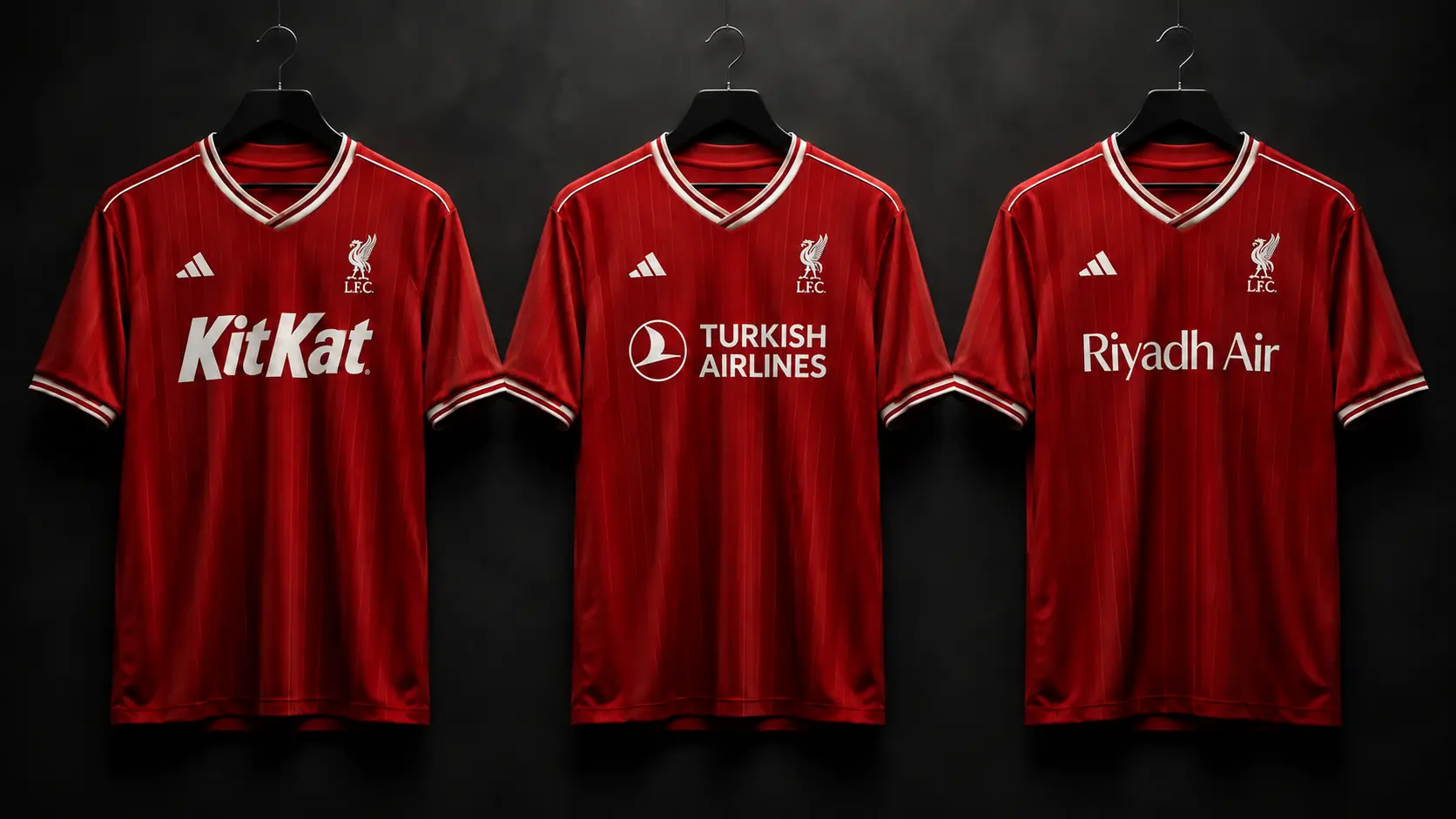
Liverpool went to market with an ambitious number.
The club wanted around £80 million a season for the front of its shirt, well above the approximately £50 million currently paid by Standard Chartered. Turkish Airlines has now secured the asset from June 2027 under a five-year agreement widely reported to be worth more than £300 million.
Neither side has disclosed the precise fee, but the reported value puts the deal somewhere above £60 million a season.
That is still a major contract and, according to reporting around the agreement, the Premier League's most valuable standalone front-of-shirt sponsorship. But it is materially below the number Liverpool had been testing.
SportsGlare reported on 30 August that Nestlé and Riyadh Air were among the companies in discussions. Nine days later, Liverpool announced Turkish Airlines.
The negotiations themselves will have been running for longer, but the speed with which the process was resolved is notable. The new sponsor does not need to appear until the 2027/28 season, so Liverpool was under no obvious pressure to close early.
Riyadh Air changed the room
SportsGlare understands Riyadh Air withdrew because it did not consider itself operationally ready for a sponsorship commitment of this scale.
That matters because Riyadh Air was one of the bidders with a clear strategic reason to pay aggressively. As a new airline still building international awareness, Liverpool offered instant reach across many of the markets it ultimately wants to serve.
The difficulty is that Riyadh Air is still building the airline beneath the brand. Its aircraft programme has suffered delays, its own route network remains relatively young and much of the connectivity it wants to offer is still being assembled through airline partnerships.
A Liverpool sponsorship at anything approaching £80 million a year would also need to be activated properly across routes, markets, loyalty, hospitality and customer acquisition. If Riyadh Air decided it was not yet ready to do that at Liverpool scale, one of the buyers most capable of stretching the price higher had effectively removed itself from the process.
That does not prove Riyadh Air would have paid £80 million. It does suggest Liverpool's final market looked different from the one it had initially hoped to create.
The market settled nearer £60 million
Liverpool's £80 million target represented roughly a 60 per cent increase on the reported value of the Standard Chartered agreement. Reaching it was always likely to require either a buyer with an unusually strong strategic need or genuine competition between several companies.
Independent valuation work had been more conservative. The Sponsor's fair-market-value index put Liverpool's front-of-shirt rights at around £61.1 million.
The Turkish Airlines agreement appears to have landed almost exactly in that territory.
That makes the deal useful price discovery. Liverpool wanted to establish an £80 million benchmark, but the signed agreement suggests the current market was much closer to £60 million.
The difference is important. Asking prices, valuations and signed contracts are not the same thing. Liverpool's target showed where the club wanted the market to move. The Turkish Airlines contract shows where an actual buyer was prepared to close.
Once Riyadh Air stepped away, certainty may simply have become more valuable than continuing to chase the higher number. Turkish Airlines already has the network, distribution and commercial infrastructure to activate Liverpool globally from day one, while a five-year agreement removes a major commercial uncertainty well before the 2027/28 season.
Turkish Airlines has seen this before
There is also a relevant precedent in how Turkish Airlines has entered major football properties.
In 2022, Crypto.com had been negotiating a major Champions League sponsorship before pulling out. Turkish Airlines then stepped in, with UEFA announcing the airline as a partner on 5 September, one day before the group stage began.
GlobalData subsequently estimated the Turkish Airlines agreement at around $60 million a year and put the value associated with the collapsed Crypto.com arrangement materially higher.
The packages cannot be compared directly, and one deal does not establish a formal buying strategy. But the sequence is worth noting. Turkish Airlines has previously shown that it can move quickly when the commercial picture around a major football property changes.
Liverpool was not in the same position as UEFA. There was no last-minute vacancy and the club still had almost a year before the new sponsor needed to appear. But the dynamic is familiar enough to be interesting: a premium buyer drops out, the market resets and Turkish Airlines is ready to transact at a price that works for it.
Nestlé remained another credible name in the process, but interest is not the same as a bid, and a bid is not the same as £80 million.
The final outcome therefore looks less like a failed £80 million auction than a process whose competitive tension weakened before the deal was signed. Riyadh Air's withdrawal appears to have removed one of the buyers with the clearest reason to stretch the valuation, while Turkish Airlines was ready to offer certainty at a price much closer to the market's existing view of the asset.
Liverpool did not establish £80 million as the new benchmark for elite shirt sponsorship. What it did establish is that, with this group of buyers and in this market, one of football's most valuable shirts cleared at a little over £60 million a season.
Sources
SportsGlare reporting: Riyadh Air withdrew after concluding it was not operationally ready for a Liverpool-scale commitment.
- Liverpool FC, Turkish Airlines announced as main club partner from 2027/28
- The Guardian, reported five-year deal worth more than £60m a year
- The Sponsor, Fair Market Value Index
- SportsGlare, original Liverpool shirt-sponsor reporting
- Turkish Airlines, UEFA Champions League sponsorship announcement
- GlobalData, Turkish Airlines' Champions League sponsorship analysis