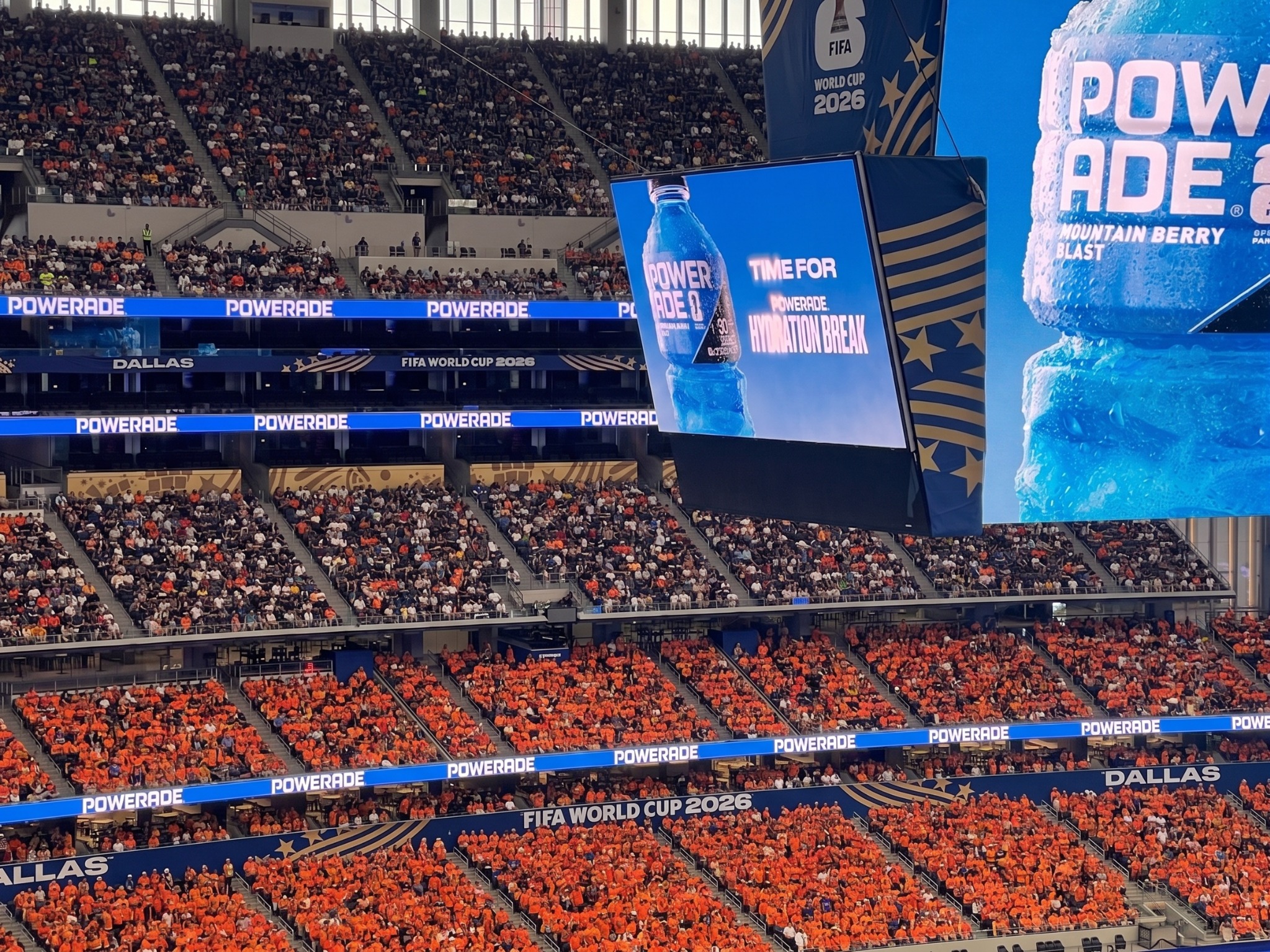
Midway through every World Cup half this summer, the familiar 45-minute rhythm paused. Players went to their bottles, managers gathered their teams, and stadium screens lit up blue for the Powerade Hydration Break.
What looked like a simple welfare measure had quietly become something bigger: a new live-match format with a job for everyone. Players could recover. Coaches could reset. Broadcasters had a natural editorial break. And Powerade had acquired a sponsorship property that made perfect sense at the exact moment it appeared.
Football has not suddenly become American football. But it may have found the rare interruption that improves the product instead of merely interrupting it.
FIFA’s World Cup protocol was deliberately exact. The referee stopped play around the 22nd minute of each half for three minutes, regardless of weather, temperature or whether a stadium had a roof. If play had already stopped for an injury close to that point, the break could be dealt with there. It was a universal tournament intervention, not a referee improvising on a punishing afternoon.
That distinction matters. Football’s Laws already recognise different kinds of heat-related pause, but they do not treat them alike. Law 7 says a drinks break should not exceed one minute; a cooling break can run from 90 seconds to three minutes, with time added at the end of the half. FIFA used the larger version. Its decision followed the 2025 Club World Cup, where oppressive conditions made the issue impossible to ignore, but the World Cup rule was also a piece of event design: two fixed moments that everybody in the stadium and at home could understand.
The health case is straightforward. In severe heat, players need fluid, shade and a chance to lower the strain on a body that is trying to sprint, think and regulate its temperature at the same time. The point is not that a three-minute pause makes extreme conditions harmless. Researchers and player representatives have argued that, in the toughest weather, the break needs to be longer and accompanied by stronger measures such as lower heat thresholds, altered kick-off times and the option to postpone. But a well-run interval is better than asking players to wait until half-time while the match keeps asking questions of them.
It also gives the match a small moment of care that television can show properly. A presenter can explain the conditions. A reporter can relay a tactical adjustment. Viewers can see who is receiving attention and who is getting instructions, rather than discovering a problem only when a player cannot continue.
A break the game already understands
The old objection writes itself. Football’s spell is its continuity: 45 minutes of play, a half-time reset, then another 45. Its lack of formal timeouts is not an accidental quirk. It is part of the game’s tempo, and part of why a single goal can feel as though it changes the air in a stadium.
That is exactly why the World Cup version was more interesting than a conventional stoppage. It did not ask football to accept a sequence of coach-called breaks or a running clock. There were two pauses, both referee-led, both brief and both timed to a practical moment in the half. The clock kept its authority because the lost time was added. The game was still recognisably itself when it restarted.
For coaches, though, the value was obvious. A scheduled three minutes creates a compact team meeting without the theatre of a touchline message getting lost in the noise. It is enough time to move a winger, settle a pressing trigger, prepare a substitute or tell a side that has been rattled to take the sting out of the next five minutes. France coach Rudi Garcia captured the dual purpose during the tournament when he called it “a coaching break more than a cooling break”.
That need not be a criticism. Tactical information has always entered a match: through half-time, substitutions, injuries and a captain carrying a message from the sideline. The hydration break simply makes a small part of that exchange visible and equitable. Both teams get the same window. Neither has to manufacture an injury or wait for the ball to go out of play.
Nor does a pause guarantee a decisive tactical swing. Football is too chaotic for that. Sometimes the team talk will be forgotten by the next loose pass. Sometimes the real benefit will be that a player catches their breath and plays the final 20 minutes with a little more clarity. The case is not causation. It is opportunity.
The sponsor finally fits the moment
The commercial innovation is more elegant than the usual debate admits. Football has long had drinks brands around the pitch, on coolers and in generic advertising breaks. The Powerade Hydration Break made the product part of the occasion without pretending it was something else. At the exact point athletes drank, a hydration brand became the natural visual and verbal partner.
Powerade was FIFA’s official sports drink and presented the breaks as part of its World Cup campaign, alongside branded hydration stations and field-of-play coolers. The blue screens gave that partnership a clear ritual. It was not just a logo occupying spare inventory. It was a recognisable piece of the match, with a name, a visual language and a reason to exist.
That creates a useful sponsorship category: the functional match moment. A brand can own the pause, but the pause still does a job for players and spectators. For organisers and rights holders, that is more valuable than simply finding another place for a perimeter-board rotation. It packages an asset that is predictable, easy to explain and relevant in every territory.
Broadcasters saw the same opportunity, although not all used it in the same way. FIFA’s operating guidance allowed a commercial window after the referee’s whistle, provided coverage returned before play resumed. Reuters reported that the usable slot was roughly two minutes and ten seconds, after allowing 20 seconds at the start and 30 seconds before the restart. Fox used full-screen advertising in the United States. Telemundo, by contrast, stayed with analysis and match coverage rather than a conventional advertising break.
That split is healthy. It shows that the pause is not a compulsory advertisement disguised as a medical measure. It is a dependable piece of live programming that a broadcaster can commercialise, explain, analyse or hand to its digital production. A public-service feed, a subscription service and a free-to-air commercial channel do not need to treat the same three minutes identically.
For viewers, especially those now watching with a phone nearby and a stream that offers endless alternatives, the interval can work as a chapter break. It is a chance to catch up on a replay, hear why a team has changed shape or take a breath before the match turns again. There is no published evidence that a cooling break improves younger-viewer retention, and it would be foolish to claim that one exists. But the broader shift towards streaming and multi-platform sport means audiences are already used to a more modular live experience. A short, useful reset may be easier to live with than an unexplained injury delay or a long run of dead-ball administration.
Keep the bargain honest
There is a line football should protect. A hydration break must remain a welfare-led, competition-controlled pause, not a pretext for adding commercial inventory to ordinary matches. The right safeguards are simple: the medical case should lead where conditions demand it; the duration should stay tight; the referee should retain control; and competition rules should be clear about added time, broadcast access and coaching behaviour.
FIFA has not announced a standing rule that requires this World Cup model at every future FIFA match. Nor has IFAB rewritten the Laws to create a permanent television timeout. Outside the tournament, cooling breaks remain subject to competition regulations and heat protocols, not a universal commercial format.
That caution is sensible. In dangerous heat, the break may need to be longer, or the match may need to move. In ordinary conditions, some competitions will decide that uninterrupted football remains the better product. Supporters are entitled to resist anything that turns a game into a sequence of interruptions.
But the World Cup has shown that the choice is not simply between pure football and imported television culture. There is a middle ground: a tightly bounded pause that makes athletes safer, gives coaches a fair tactical window, creates a sponsor property with genuine relevance and lets broadcasters serve different audiences without cutting into live play.
The real test will come the next time the screens turn blue. If players return better protected, managers have clarified rather than cluttered the contest, the broadcast has added useful context and the crowd is ready for the restart, football will not have lost three minutes. It will have made them count.
Sources
- FIFA, “Hydration breaks to be implemented at every FIFA World Cup 2026 match”
- The IFAB, Laws of the Game 2025/26, Law 7: The Duration of the Match
- The Coca-Cola Company, “Powerade: Power Your Legacy campaign for FIFA World Cup 26”
- Reuters, “Hydration breaks heat up World Cup debate with players, coaches split on new rule”
- The Guardian, “Fox hydration-break rules on ads at World Cup draw FIFA sanction”
- FIFPRO, “Scientific study to better understand how extreme heat affects players”
- Nielsen, “Nielsen reveals new data and insights in annual tops of sports report”