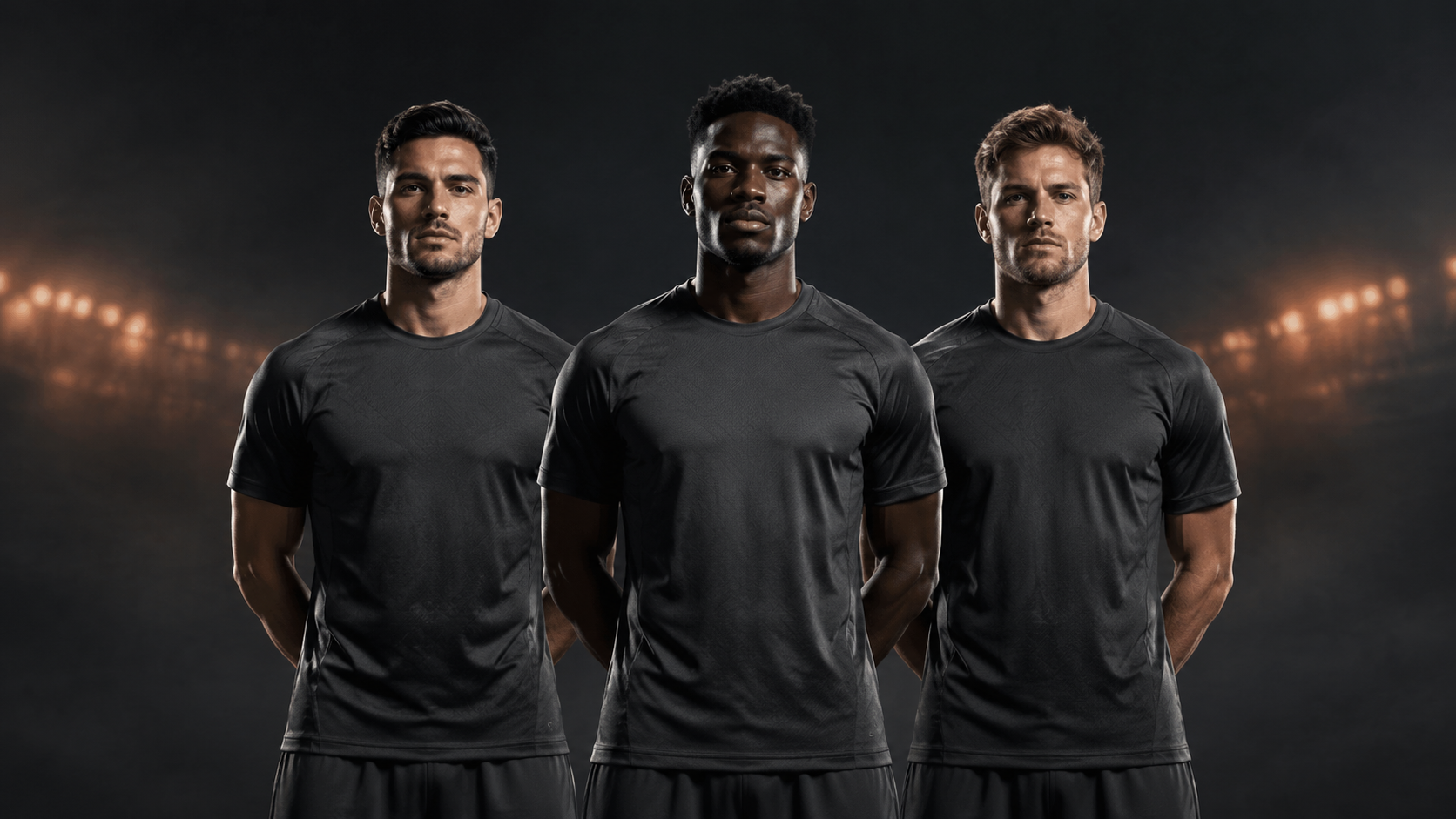
Football sponsorship has developed a house style.
Three players stand in a row, in full kit, arms folded and faces set to serious. The captain is generally in the middle. A sponsor logo fills the empty space. Sometimes all three attended the same shoot. Quite often they did not. They were photographed separately, clipped from their original backgrounds and arranged into a line-up which only exists in the final artwork.
The image is not everywhere by accident. It is the visual consequence of a commercial compromise. A club can usually sell its team identity to a partner. It cannot automatically sell a player’s personal endorsement. Put several players together and the brand is using the club’s collective asset. Put one player alone beside a product and the campaign may be using that footballer’s individual commercial identity.
That does not make an individual player image more valuable. It makes it a different asset, bought from a different rights holder and carrying different risks.
The resulting shorthand is known in football as the three-player rule, or sometimes the five-player rule. It has become so familiar that the number is often mistaken for a universal legal safe harbour. It is neither. FIFA and UEFA have no general three-player rule. European law does not have one. Even the markets that have adopted a numerical test do not let a brand settle the entire rights question by counting faces.
Still, the convention is useful. For a marketer planning a club campaign, three balanced same-team players is the most portable starting point. It usually signals team content rather than a personal endorsement. It is a creative starting point, though, not a clearance certificate. The contract, the jurisdiction, the competition, the image licence, the wording and the prominence of the players still decide the answer.
The commercial divide behind the line-up
A sponsorship package is a bundle of different rights. A partner may have permission to use a badge, describe itself as an official partner, film at the training ground, receive club-produced content or stage player appearances. It may not have permission to use the player it most wants as a personal spokesperson.
The distinction is easy to understand in practice:
- A balanced image of several players can say: “We support this club.”
- A named striker holding a product can say: “This player supports us.”
The first is usually a club proposition. The second may be a player proposition. The fact that the player is in club kit does not make the second proposition disappear.
The number is a fast way of policing that boundary. It gives a commercial team something practical to work with when a partner needs a social tile or an out-of-home campaign. It also protects a player who has built a separate portfolio of personal sponsors, particularly in categories such as betting, alcohol, financial services, sportswear and technology.
What it cannot do is change the point of the campaign. Five players can surround a star who is centred, enlarged, named in the copy and used as the reason to buy. That is still likely to feel like an individual activation. Equally, a live goal celebration can be a genuine team asset even when one scorer is naturally the focal point. Context matters.
The marketer’s map: how to use the major markets
The practical rule is not the same in every territory. This is the most useful starting point for club and agency teams before they open the deal documents.
| Territory | Working route for a club sponsor | When to obtain individual player clearance |
|---|---|---|
| Italy | Use at least three registered players from the same club, in a genuinely collective composition. This is the clearest published three-player rule. | A one-player advertisement, or any creative that makes one player the commercial hero. |
| Spain | Treat five players as the common club-marketing convention, particularly for polished sponsor creative. It is a commercial norm, not a statutory safe harbour. | Any individual or clearly star-led activation, because Spanish law protects commercial use of a person’s image. |
| England | Start with the club-player contract. A balanced group can be a club-delivered asset, but there is no national number that clears it. | Any use that could imply the player recommends, backs or is associated with the brand personally. |
| France | Five players is the familiar collective threshold, especially in national-team work. The wider French framework also treats fewer than half a football side as individual use. | Fewer than five, or any use outside the club or federation’s agreed collective programme. |
| Netherlands | Use a real team moment or a balanced club group, with the club contract and image source checked. The CBA’s 11-player rule is for a division-wide league pool, not a club campaign. | A star-led ad, a new player shoot, a category conflict or any use that relies on the player’s personal pulling power. |
| Belgium | A club may be able to use even one player for a sponsor promotion when the sector model clause is incorporated into the player contract. | When the clause is absent, the category is sensitive, the use extends beyond the defined sponsorship programme or the player is presented as an ambassador. |
| Portugal | Treat imagery of the same team as the club’s collective route. There is no published player minimum. | A single-player campaign, or a use outside the club-team collective. |
| Germany | Treat consent and the player contract as the starting point. A team group is operationally safer, but no statutory three-player rule exists. | Any promotional use in which the player is identifiable as the brand’s message rather than part of the team scene. |
This is a guide to the commercial route, not a substitute for the relevant contracts. It does, however, correct one widespread misunderstanding: “three players” is not the answer in all countries. It is simply the most recognisable club-football convention.
Italy is the cleanest three-player example
Italy is where the shorthand has been written down most clearly. The AIC-Lega Serie A collective agreement signed in July 2025 defines collective image as imagery that evokes the team and contains at least three registered players from the same club. It may be posed, captured in a match or taken at training.
The club can exploit that collective image commercially, including alongside brands and products. The agreement also limits collective promotional activity to 30 hours a season and requires player rotation. Individual advertising appearances sit outside that collective route unless another agreement says otherwise.
For an Italian club partner, the practical lesson is unusually clear. Three same-club players in a balanced goal celebration can be a collective asset. Three cut-outs with one player made twice as large, named in the headline and paired with a purchase prompt are much harder to describe as collective in spirit. The number opens the door. The creative still has to walk through it honestly.
Spain uses five as a convention, not an escape clause
Spain is often described as a five-player market. That is a useful planning convention for agencies and commercial teams, particularly where a sponsor wants a polished, reusable group visual. It is not a legal proposition that five players erase individual rights.
Spanish law is clear about the starting point. The Organic Law protecting honour, privacy and one’s own image treats the commercial or advertising use of a person’s name, voice or image as an unlawful interference unless the use is authorised or another legal exception applies. The law gives public figures latitude where they are pictured at public events or in public places, but that is not a free pass for a brand to turn match imagery into advertising.
So five should be treated as the team-content lane, not as a way to disguise a personal endorsement. A five-player campaign that is balanced, visibly about the club and within the club’s image-rights package is a sensible route. A five-player campaign in which one footballer is the entire hook needs the same caution as an individual deal.
That is particularly relevant for goal celebrations. A real photo of several players celebrating can be more natural, more compelling and less artificial than the traditional studio line-up. It may also be easier to explain as club storytelling. But if the caption is “X delivers again. Download our app”, the use has shifted towards the named player’s commercial pull. The photograph has not changed. The proposition has.
France explains why five has become so familiar
The five-player figure has a firmer legal ancestry in France than many people realise. France’s general national sports collective agreement, where a sport-specific agreement does not provide another answer, defines a collective associated image as at least 50 per cent of the players present on the field. In football, that is five. Below the threshold, it treats the image as individual and requires the player’s contract or prior agreement for employer or partner use. The current text is published on Légifrance.
The French sports code is equally direct about the commercial point. It treats the use of at least one player’s image, name or voice alongside the club’s signs on a sponsorship or merchandise support as individual exploitation for the purpose of the statutory remuneration scheme. Article D222-50 makes the distinction explicit.
The French national team has made the practical significance visible. The dispute led by Kylian Mbappé in 2022 was not principally about whether he could be photographed. It was about whether a federation collective-rights arrangement could repeatedly put him in campaigns for brands he did not want to be associated with, including betting and fast-food partners. The five-player collective became the operating language of that argument.
For brands, France therefore offers a useful lesson. A five-player threshold can make a campaign collective, but it does not make player objections irrelevant. A group creative designed around betting, alcohol or another sensitive category can still produce the same commercial and reputational problem that the rule was meant to avoid.
The Netherlands counts 11, but not for this purpose
The Netherlands is the easiest market to misread. Article 22 of the 2023-27 professional football CBA requires proportionate use of all clubs’ marks and at least 11 players from each club for a division-wide collective commercial-rights pool. That is a league-product rule. It is not an instruction that a club sponsor needs 11 Eredivisie players in an advert.
For ordinary club campaigns, the legal backdrop is the Dutch portrait right. Articles 20 and 21 of the Auteurswet protect commissioned portraits through consent and uncommissioned portraits where the subject has a reasonable interest against publication. In other words, the fact that a photograph exists, or that the photographer licensed it, does not end the player-rights analysis.
The 2020 Albert Heijn football-sticker decision shows the practical difference. A court allowed the supermarket to use an individual former ADO Den Haag player’s portrait in material promoting the nationwide sticker collection because the campaign promoted the collective product rather than the footballer’s individual fame. The court’s summary is a useful answer to the common question, “Can we use a player in a club campaign?” Yes, potentially, when the image is serving a real collective product or team story. No, not simply because the brand would prefer that player’s face.
For a Dutch club sponsor, a wide, joyful celebration, a group training moment or a rotating team-content series can be a much better route than a static player line-up. The key is that it needs to be genuinely team-led and come from a rights-cleared source.
Belgium can be more permissive, if the contract says so
Belgium is the market that most clearly demonstrates why face-counting is incomplete. The model image-rights clause attached to the 2022 sectoral CBA contemplates club and league use of a player’s image individually or as part of a team for club or league promotion and sponsor activations directly connected to the relevant sponsorship agreement. It also contains a mechanism for handling conflicts between a player’s sponsors and the club’s sponsors.
If that model clause has been incorporated into the player’s contract, the club may have a route to provide a sponsor with individual player content. There is no need to invent a three-player threshold where the agreement already spells out a broader commercial permission.
The practical caution is equally important. The clause is a model, not a guarantee that every player in the Pro League has signed identical terms. And a right to use a player in a defined club sponsor activation is not necessarily a right to make that player a long-term independent ambassador for the sponsor. Scope, category, territory, paid media and approval still matter.
A 2014 Brussels appeal concerning a Belgian national-team photograph on the cover of a football annual is a useful counterpoint. The court did not find infringement in that editorial context. It does not mean that a brand can rely on the same image in a commercial campaign. Editorial and advertising uses sit on different sides of the line.
Portugal separates the player, the team and the profession
Portugal’s current Liga Portugal-SJPF CCT provides a more elegant map than a headcount. Article 38 leaves individual image rights with the player, unless the player assigns them to the club. It reserves the image of players from the same team as a collective to the club. It gives commercial exploitation of professional players as a wider collective to the SJPF players’ union.
For marketing teams, the result is straightforward. A real same-team group image can travel through the club route. A single scorer or individual studio portrait belongs in the player route unless the contract says otherwise. Portugal’s courts have repeatedly treated the unauthorised commercial use of footballers’ images as actionable, including disputes over sticker collections and video-game likenesses. A Lisbon Court of Appeal judgment makes the principle plain: the commercial exploitation of a footballer’s image can be licensed, but it needs consent.
That makes a group goal celebration a practical creative option, not an automatic exception. It is safer when it is about the team’s moment, sourced from the club or authorised rights holder, and kept within the club’s collective licence.
England and Germany start with consent, not a number
England has no standalone general image right and no published Premier League player threshold. The legal risk lies in the contracts and in whether the campaign implies a false personal endorsement.
The leading English case remains Irvine v Talksport. Talksport had licensed a photograph of Formula One driver Eddie Irvine from a picture agency, then altered it to make him appear to be listening to a Talksport-branded radio. The court held that the campaign could amount to passing off through false endorsement. The copyright licence for the photograph did not answer the endorsement problem.
Football teams should read that case as a warning against clever edits. A club may have a photograph. An agency may have licensed it. A player may be in a recognisable kit. If the finished work gives the target audience the impression that the player personally supports the partner, a separate player right may still be engaged. In England, the safe workflow is contractual rather than numerical: use the club package for real team content, and secure an individual deal for a player-led message, testimonial, voice-over, social post or obvious hero treatment.
Germany begins even more directly with consent. Sections 22 and 23 of the Kunsturhebergesetz say that images generally require the subject’s consent, subject to limited exceptions for matters of contemporary history, crowd and event images, and certain other contexts. Those exceptions help news reporting. They do not turn a photograph of a football match into a general advertising licence.
For German club sponsors, three or more balanced players can be a sensible contractual collective asset. It is not a statutory rule. A one-player campaign, particularly in paid media, should be treated as a player clearance exercise.
Can brands get beyond the cardboard line-up?
Yes. In fact, they often produce better work when they do.
The safest creative solution is not always three posed players. It is a campaign in which the team, club or competition is genuinely the subject. A supporter sees that immediately. So does a lawyer.
1. Use a real collective moment
A goal celebration, a huddle, a pre-match tunnel walk or a group training scene is usually more alive than a row of cut-outs. It can also be closer to the collective purpose of a club sponsorship package. The number of players remains relevant in a market such as Italy or France, but a genuine team moment is harder to mistake for a concealed personal endorsement.
It is not a free exception. The brand must have the right photograph or footage licence, the relevant club or competition right, and a use that stays within the player agreement. Match footage is often harder than a still photograph because broadcaster and competition rights sit on top of the club and player layer.
2. Let the club, not the player, be the protagonist
The best alternatives draw on the things a club owns more clearly: the badge, kit textures, stadium architecture, matchday rituals, supporters, chants, a rotating set of player numbers, club data, historic moments and the collective rhythm of the season.
This does not mean avoiding players. It means letting them appear as part of a club world rather than treating one of them as a borrowed celebrity. A partner can own a “late winner” series, a matchday-arrival format or a fan prediction without anchoring every execution to the same forward.
3. Rotate and equalise
Where a collective-rights clause requires rotation, that is a legal obligation. Elsewhere, it is also good creative discipline. A series that uses different combinations of players, none consistently larger or more central, is easier to defend as team content. It also prevents one player from becoming the unpaid face of a sponsor relationship.
4. Buy the individual asset when it is actually needed
There is nothing wrong with a hero campaign. It just needs an honest rights route. A proper player deal can cover the name, likeness, voice, personal social channels, kit, category, territories, media, paid amplification, duration and approval. It allows the brand to produce a stronger idea rather than hiding a star behind two teammates.
5. Use the competition property that has actually been bought
Competition partners have another option: authorised awards and event inventory. A Player of the Match property can put one winner next to a sponsor because the award is the commercial asset. A pitch-side board in a licensed match photograph can demonstrate partnership presence. Neither route creates a general right to repurpose the same player as a personal endorser.
The distinction may sound fine, but it is workable. The question is whether the campaign is documenting a rights-holder asset or using the footballer’s fame as the product.
UEFA and FIFA: a partner buys the competition, not every player
UEFA’s current Champions League regulations allow the competition to use player and team material for its commercial programme, while prohibiting UEFA, its subsidiaries and its partners from creating a direct association between an individual player or club and a partner without separate consent. The EURO regulations make the same distinction for national teams.
That is why PlayStation can present the Champions League Player of the Match and Vivo could present EURO 2024’s equivalent. The sponsor is attached to a defined competition property, not handed a blank personal endorsement from every winner.
FIFA’s public World Cup 2026 guidance likewise makes clear that partner marketing is approval-based and does not determine third-party rights held by players, clubs or associations. The public senior tournament comparators are instructive. FIFA’s Women’s World Cup 2023 media and marketing regulations forbid uses that imply a player or association endorses a commercial affiliate. For non-editorial use, they permit a participating-association asset with the assets of at least three other associations and/or a competition mark, while requiring balanced prominence. That is an association-asset rule, not a player threshold.
The sponsored-award exception completes the picture. FIFA can centre an individual in a partner-branded official award, as it did with the Michelob ULTRA Superior Player of the Match. The sponsor has bought an award property. It has not bought the winner’s personal recommendation.
The ADI Predictstreet Messi post: competition storytelling, with a boundary
ADI Predictstreet’s LinkedIn post after Lionel Messi’s record-breaking goal against Austria is the useful test case because it does not fit the cardboard line-up at all.
The six-image carousel, published on 22 June 2026, named Messi, showed him shooting with a large ADI board behind him and described the company as part of the matchday experience. ADI was an official World Cup 2026 prediction-market partner.
On the facts visible in the post, the better reading is that ADI was documenting its official tournament asset, not presenting Messi as a personal endorser. The photograph showed a real match moment and real stadium inventory. The copy was built around a World Cup record and did not say that Messi used, recommended or vouched for the service. That is materially different from placing him in a studio composition beside a product or using his voice in a campaign.
Messi is still the reason the post travelled. That does not itself convert a competition post into an endorsement. Event partners are allowed to demonstrate the value of the property they bought, and football’s biggest moments are inevitably player-led.
The boundary would move if the same image were cropped to remove the match context, inserted into a product advert, paired with a call to trade, used repeatedly in paid media or recast as a long-term ADI campaign. Those changes would make Messi, rather than the tournament inventory, the thing being sold.
The lesson for brands is more useful than a verdict on one post. A player can be central in an authentic sporting moment without being the brand’s ambassador. What matters is the asset source, the surrounding copy, the use of the image and whether the work asks the audience to infer personal support.
Why there are fewer reported cases than the creative suggests
There is more law here than the small number of reported sponsorship-photo cases implies. The disputes usually surface elsewhere: sticker collections, video games, merchandise, tax structures, agency representation agreements and takedown negotiations. The contracts are confidential, the images are often removed quickly and the commercial relationship usually has more to lose from a public court fight than from a settlement.
The available decisions nonetheless give the same answer from different directions:
- In England, Irvine v Talksport shows that a paid photo licence does not permit a false impression of personal endorsement.
- In the Netherlands, the Albert Heijn decision shows that use of one player can be legitimate where the product being promoted is genuinely collective.
- In Portugal, the courts have accepted that footballers may license commercial exploitation of their images, while unauthorised commercial use can produce damages.
- In France, the statutory and collective-agreement structure distinguishes individual from collective image use and expressly links individual player use to sponsorship revenue.
The thread is simple. No court needs a global three-player rule to decide these cases. It can ask what the brand used, what it bought, what the player agreed to and what message an ordinary audience would take from the campaign.
The rule will survive. The line-up should not have to.
The three-player convention survives because it solves a real problem. Clubs need an efficient way to sell team identity. Sponsors need predictable access to useful content. Players need to retain control of the individual commercial partnerships that make up a growing part of their income.
But the line-up is only one answer. The strongest modern rights packages should say more about prominence, category conflicts, synthetic likeness, paid amplification, territory, term, approvals and the split between a real match moment and a personal endorsement. They should give brands permission to make better team content and a clear route to buy star-led content when that is what the campaign genuinely requires.
Three players can make a collective image. Five can too. Neither number can make an endorsement disappear when one footballer is still the whole point.
Sources
- AIC-Lega Serie A Collective Agreement, July 2025, collective image definition and club exploitation rights.
- Spain, Organic Law 1/1982, commercial use of image, name and voice.
- France, national sports collective agreement, collective associated image threshold.
- France, Sports Code Article D222-50, sponsorship-related individual exploitation.
- Netherlands, 2023-27 professional football CBA, division-wide collective commercial-rights pool.
- Netherlands, Auteurswet, portrait rights.
- Belgium, 2022 sectoral CBA and model image-rights clause.
- Portugal, Liga Portugal-SJPF CCT, Article 38.
- Germany, Kunsturhebergesetz sections 22-23, consent for image use.
- UEFA Champions League Regulations, Article 77.
- UEFA European Football Championship Regulations, Article 70.
- FIFA World Cup 2026 IP Guidelines.
- FIFA Women’s World Cup 2023 Media and Marketing Regulations.
- Irvine v Talksport, England’s leading false-endorsement case.
- Albert Heijn football-sticker ruling, Netherlands.
- Brussels appeal analysis, editorial rather than advertising use of a national-team photograph.
- Lisbon Court of Appeal judgment, commercial exploitation of a footballer’s image.
- L’Équipe / JDD reporting on the Mbappé collective-image dispute, supporting context on France’s national-team arrangements.
- ADI Predictstreet LinkedIn carousel, 22 June 2026.
- FIFA announcement of ADI Predictstreet as official World Cup 2026 prediction-market partner.
- FIFA on the Michelob ULTRA Superior Player of the Match.