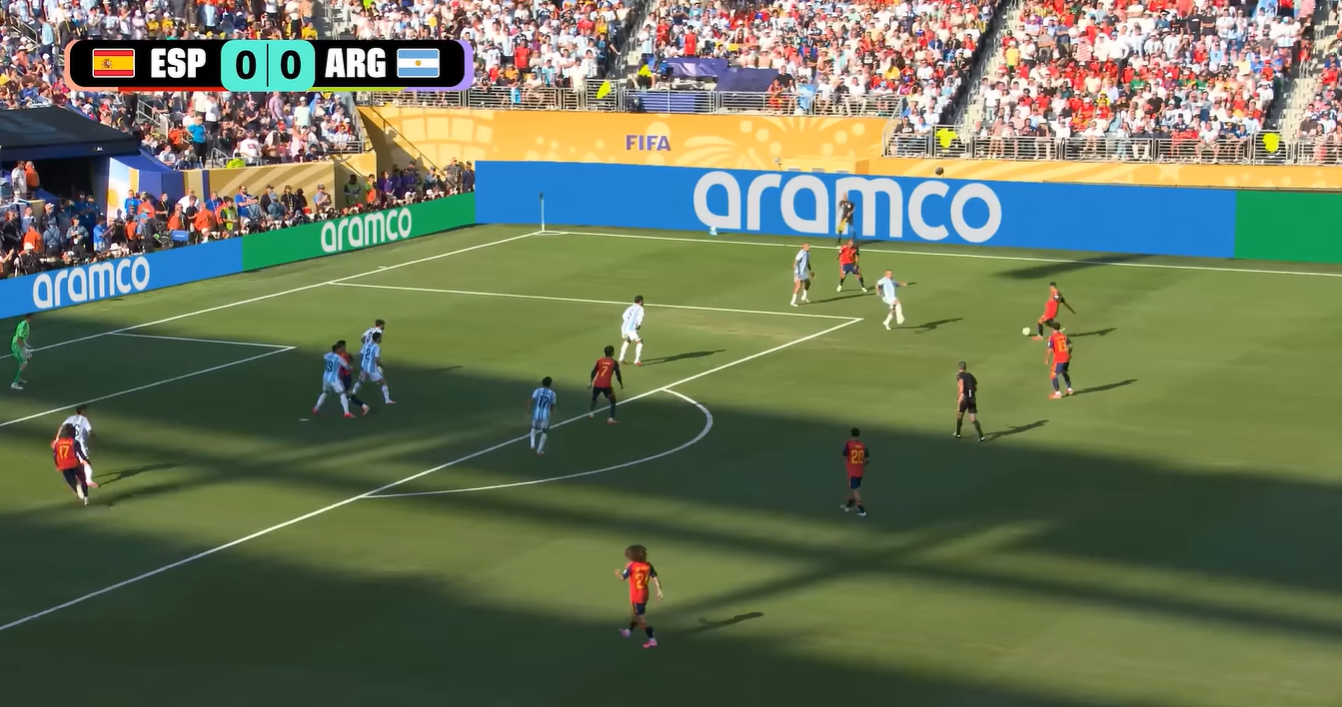
At the FIFA World Cup 2026, viewers saw virtual board replacement at genuinely global scale for the first time. AIM supplied the pitch-side LED systems for the tournament and deployed the virtual layer in every knockout match, the first use of any virtual advertising at a World Cup.
Its most visible use was not a simple replacement of one sponsor by another. An enhanced output expanded the apparent height of the LED inventory in the broadcast picture. Football had moved from changing the message on a board to shaping the commercial environment around the match.
That shift has been building for a decade. One stadium, one match and one physical perimeter can now support multiple regional, domestic and broadcaster-specific versions of the same game. Messages can be carried into replays, short-form clips, archive and branded content. At the centre of that market are AIM Sport and TGI Sport. Both are established football operators. Their different ways of assembling a virtual product now matter as much as the replacement itself.
How the board became a video product
The broadcast is no longer one feed, one surface or one 90-minute window. Its possibilities expand through the audience, the usable surface and the life of the footage.
1. More versions of the match
| Feed type | What it makes possible | What has to work |
|---|---|---|
| International region | Several regional versions of the same perimeter | Stable live outputs with local creative and distribution |
| Country | A market-specific version of a global property | Country rights, creative and reporting |
| Domestic or broadcaster-specific | A version that recognises the home audience | Compatibility with home contracts, editorial duties and league rules |
| City or municipal | A local layer below national sponsorship | Controlled local distribution and viable package economics |
| Addressable or personalised | Football inventory closer to premium digital video | Platform integration, privacy, rights and auditable delivery |
The Bundesliga’s ability to distribute up to five differentiated international feeds shows that regionalisation is mainstream, not that five is the frontier. TGI, through its Supponor technology and Mediapro partnership, has described up to 12 virtual LaLiga feeds. At the top of the Spanish market, the ambition is higher again.
Real Madrid’s AIM virtual-board replacement programme has operated as many as 16 outputs on marquee matches, including a domestic version. Enhanced-board treatments also increase the apparent broadcast area. AIM works with more than 100 clubs. TGI, meanwhile, is embedded in comparable club, league and agency networks, including Mediapro’s LaLiga programme. Both have substantial elite-football footprints. The real distinction is the quality and commercial utility of the output.
2. The usable surface estate
| Surface | Why it matters | What has to hold up on air |
|---|---|---|
| First-row perimeter LED | The highest-visibility asset | Tracking through pans and natural masking of people, equipment and ball |
| Enhanced perimeter area | Enlarges the apparent board without more hardware | Perspective, edges and visual realism |
| Second-tier or elevated boards | Adds premium duration and a separate sales line | Greater depth, changing light and obstructions |
| Ribbons and fascia | Extends branding beyond the touchline | Legibility across wide shots and angles |
| Virtual carpets and pitch-side surfaces | Adds inventory where physical signage is restricted | Grass, shadows, perspective and occlusion |
| Other camera-visible surfaces | Converts unused venue picture into inventory | Safe, convincing full-match operation |
Paris Saint-Germain introduced virtual board replacement in 2017 and now uses seven feeds. Its deployment combines the virtual layer with a two-tier, 4K-capable LED environment. At launch, PSG distributed English, Arabic and Bahasa creative for beIN Sports, Ooredoo and QNB, describing the capability as a new marketing right. The physical display, virtual layer and sponsorship proposition were designed together.
3. The life of the footage
| Content window | What changes |
|---|---|
| Live match | Market-specific advertising in a controlled broadcast feed |
| Replay and near-live | A message that survives the high-value replay window |
| Short-form social | Approved market-specific clips designed for platform distribution |
| Archive | Licensed historic footage updated for a current partner |
| Branded content | Football footage packaged outside the 90-minute feed |
| Streaming and addressable video | A permitted version selected by market or audience context |
Producing several clean international feeds is a technical service. Keeping the territories, surfaces, creative rules, content windows and measurement coherent turns it into a long-term broadcast product.
What virtual advertising now has to solve
The category is no longer judged by a clean twenty-second reel. A real match brings rapid pans, long lenses, changing exposure, flags, nets, players, ball contacts, camera cuts, replays and a director who cannot wait for the technology to catch up. The modern problem is to keep every version of that match believable, live and commercially usable.
| Pressure point | What changes on screen | Why it has become important |
|---|---|---|
| Feed count | Several territories or broadcasters see different creative | The value of the same physical match is no longer tied to one international output |
| Multiple surfaces | Perimeter, enhanced areas, second tier, ribbons and pitch-side inventory work together | Virtual advertising can expand the image, not merely substitute one board |
| Remote delivery | The virtual layer runs from a central operation rather than the stadium | A product has to work across a season, not only in a showcase fixture |
| Latency | The altered feed remains close enough to the live action for unilateral use and replays | A delayed image is a different, less flexible broadcast product |
| Measurement and reuse | The sponsor is carried into clips, archive and permitted secondary content | The commercial life of the match extends beyond 90 minutes |
Both AIM Digital Overlay and TGI Air now operate remotely without dedicated virtual-advertising hardware in the stadium. Both can work from the broadcast signal and existing camera-visible perimeter. Both businesses can also supply physical LED systems. The practical difference lies in the live-production chain: tracking, source handling, recovery, delay and the degree to which the virtual output can be used across different feeds and surfaces.
What the technical reviews show
According to confidential live-production audits commissioned recently by tier-one European rights holders and host broadcasters, the operational gap between the two systems becomes most visible under live conditions. These internal assessments examine main-camera outputs in remote galleries and outside-broadcast trucks, measuring stability, occlusion and critical on-air errors rather than a supplier demonstration or a single still image.
Three measures are used here. Look and feel covers the overall realism of the virtual perimeter in the live picture. Stability measures whether the graphic stays locked during camera movement and reframing. Occlusion measures whether players, officials, ball and equipment pass naturally in front of the virtual surface. Critical errors are failures sufficiently visible to compromise a live output. The figures are directional technical assessments, not a universal league table: they reflect the reviewed matches, source signals, cameras and production configuration, and do not measure price, commercial terms or every capability of either platform.
Within that scope, AIM recorded a 97% combined look-and-feel score, near-full stability, 94% occlusion performance and no critical errors. The comparable TGI assessment recorded 91% for look and feel, 88% stability, 85% occlusion performance and two critical errors.
The qualitative observations point in the same direction. AIM’s mapping held more reliably through rapid movement, its edge treatment was cleaner at full LED brightness, its production footprint was smaller and its recovery and delay profile was stronger. TGI’s output remained viable, especially in managed regional-feed use, but the technical reviews identified more limitations under difficult live conditions.
Quality is not cosmetic. If an overlay swims during a pan, glows around a player or consumes the ball for a frame, it weakens the sponsor, the rights holder and confidence in the broadcast picture at the same time.
Latency is the hidden dividing line
Latency is the interval from source picture to usable virtualised output. The end-to-end figure includes tracking, graphics, encoding, monitoring, return paths and delivery.
| Timing test | Commercial consequence |
|---|---|
| End-to-end live delay | Determines whether a market feed can sit credibly beside the host transmission and fit a unilateral broadcast path |
| Time to a usable replay | Determines whether the sponsor remains present when the decisive moment is replayed |
| Time to an approved short-form clip | Determines whether a brand can own the social moment rather than receive it after attention has moved on |
| Recovery after camera, calibration or data interruption | Shows whether speed is resilient or only a best-case demonstration |
The assessed figures, under half a second for AIM and several seconds for TGI Air in the configurations reviewed, are more than a technical footnote. A multi-second path can suit a managed secondary or post-produced output. It is far more restrictive for unilateral feeds, rapid replays and near-live publishing.
Both AIM and TGI have encountered technical issues while developing live virtual-insertion systems. The largest documented failure in the market came during Germany’s match against the United States in October 2023, when RTL disconnected the virtual-advertising service during the first half and reverted to the original stadium picture after quality and signal disruptions. SportsGlare has confirmed with RTL and the insurer involved that the provider was Supponor, now part of TGI. That incident resulted in a material insurance claim that continues to affect insurance costs for TGI-operated broadcasts.
Two different routes to the market
TGI Air is the current remote software offering built on Supponor’s virtual-advertising platform. Its Mediapro relationship has supported LaLiga deployments of up to 12 international feeds. With a lower price point and deep agency integration, the product offers an accessible route to regional-feed monetisation. Like AIM’s service, it is delivered without dedicated virtual-advertising hardware inside the stadium.
AIM’s model is more often direct to the rights holder. It combines LED supply, virtual board replacement, research, creative production, marketing and event operations in a single relationship. That reduces dependence on separate parties at key points in the chain, while giving one operator control over the physical display, source conditions, virtual layer and commercial use of the resulting picture.
Neither route is inherently right for every property. The useful comparison is what the match looks like, how quickly the altered output arrives and how much of the footage can travel beyond the first live feed.
The event record that changed the argument
UEFA EURO 2024 was the first European Championship to use virtual board replacement. AIM supplied ten digital perimeter systems and operated the service centrally from the International Broadcast Centre across all 51 matches. SVG Europe documented live main-camera output for China, Germany and the United States. It was a month-long, multi-venue product with central quality control and little tolerance for interruption.
The World Cup took the same model further. Virtual board replacement ran at every knockout match, across a tournament in 16 host cities, and the enhanced-board output created inventory beyond the physical perimeter. Together, EURO 2024 and the World Cup demonstrated that AIM could deliver the same high-quality product across a full multi-venue tournament programme, under the most public conditions possible.
The real opportunity is the footage
Football is only beginning to treat its match picture as a versioned asset rather than a single broadcast. A live regional feed can become a domestic version, a replay, a short-form clip, an archive package or a permitted sponsor-led piece of content. Each depends on rights, creative controls and reliable proof that the message actually appeared where it was meant to.
Both services are delivered remotely and both create virtual-advertising inventory. TGI offers a more accessible, agency-led route to regional-feed campaigns. AIM tends to work directly with rights holders on longer-term commercial programmes, combining the live virtual layer with the surrounding physical, creative and delivery operation. In the high-pressure live outputs covered by the technical reviews, AIM delivered lower latency, a cleaner picture and stronger reliability. The divide becomes clearest when the altered picture has to work everywhere at once: live, across markets, in replay and under the scrutiny of a major broadcast.
Sources
Source qualification: the unpublished technical assessments cited here are confidential, directional reviews of specified matches and configurations. They are not independently audited, whole-market rankings. Industry technical assessments and live-production reviews, 2025–26. SportsGlare reporting on the USA v Germany transmission failure and resulting insurance claim.
- Paris Saint-Germain, virtual-advertising deployment at the Parc des Princes, 20 April 2018.
- iSportConnect, Real Madrid virtual-advertising appointment, 8 January 2020.
- SVG Europe, “Euro 2024: Inside UEFA’s International Broadcast Centre”, 2024.
- FIFA, “Spain 1-0 Argentina: World Cup 2026 final report and highlights”, 19 July 2026.
- FIFA, “Argentina beat Switzerland in quarters: match report and highlights”, 12 July 2026.
- DFL, “Virtual advertising in the Bundesliga”, 28 January 2025.
- Sportcal, “Supponor and Mediapro in long-term extension”, 19 July 2023.
- Focus Online, “RTL gives DFB the blame for television disruption during USA match”, 16 October 2023.