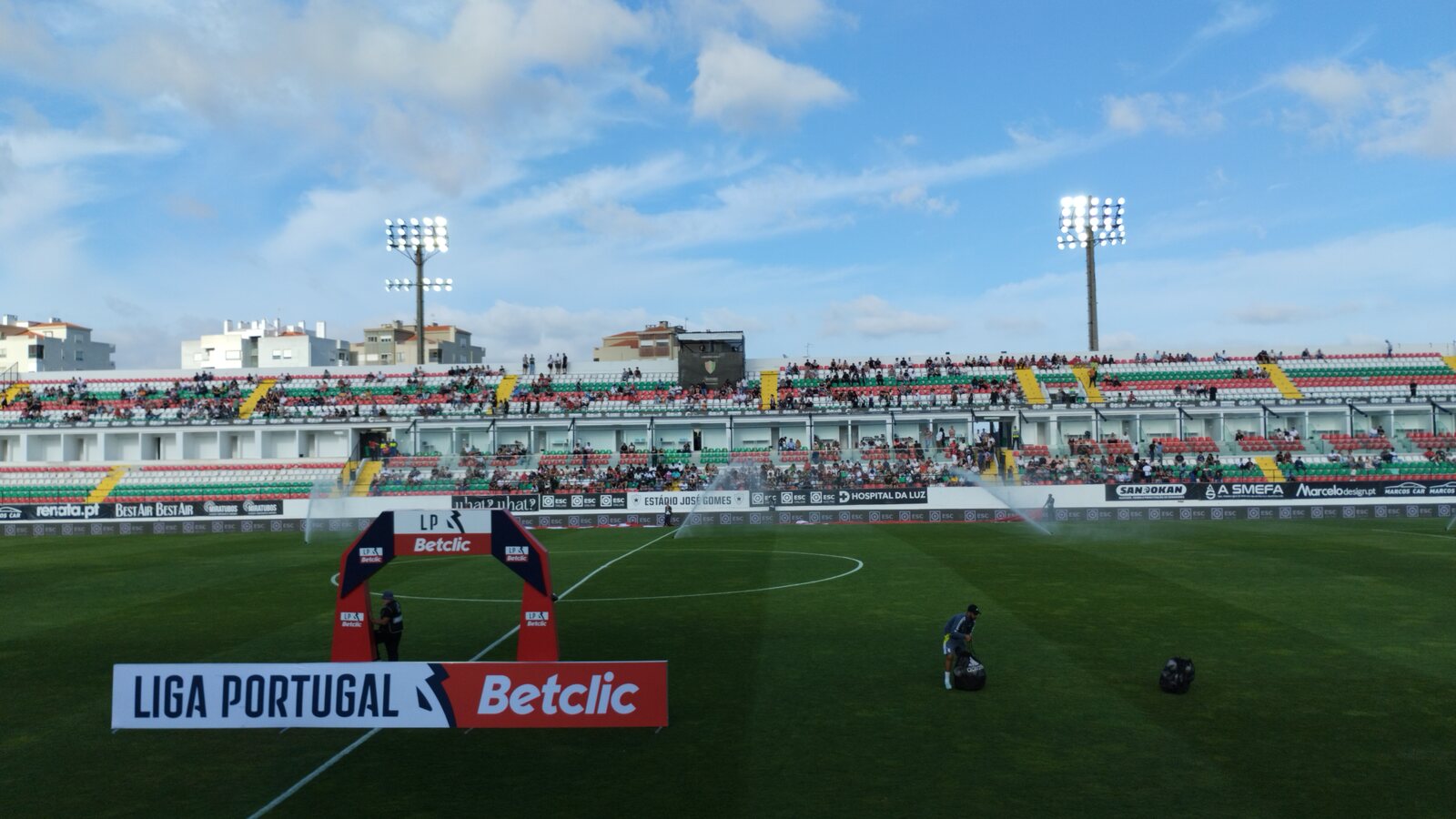
When Estrela da Amadora confirmed on 25 August that 90% of its football company had been sold to an international consortium, the headlines wrote themselves.
Thomas Müller, Mats Hummels, Yann Sommer and Lucas Hernández were among the investors. Alexander Bente brought the Adi Dassler family connection. Johannes Mösmang, after roughly a decade in Bayern Munich’s professional-player operation, became president of the SAD.
The reported consideration was even more striking: around €40 million.
For a club that had just finished 15th in Portugal, surviving relegation only on a head-to-head tiebreaker, the price stood out far more than the names. The club did not disclose the consideration, but Portuguese reporting has consistently put the transaction at approximately €40 million. If that figure represents the price paid for 90% of the shares, it implies a €44.4 million value for 100% of the equity.
That is a striking number for a business whose latest accounts showed negative equity, almost no operating profit and a balance sheet that, only months before the sale, was the subject of an attempted restructuring of more than €25 million of creditor claims.
On current financial performance alone, the reported price is difficult to explain. It makes more sense if the buyers believe they have acquired a football platform that can look very different in five years.
The €40m question
The first question is what, precisely, the €40 million covers.
Most reporting after completion describes it as the price for the 90% stake. Earlier reporting, while negotiations were still under way, referred instead to an overall investment of around €40 million. Those descriptions may ultimately amount to the same thing, but they do not have to.
No public disclosure sets out how much went to existing shareholders, whether shareholder loans changed hands, whether debt was refinanced at closing or how much fresh capital has been committed to the club itself. That distinction matters at Estrela because buying the shares and financing the project are plainly two different things.
The new owners have already spoken about further investment in infrastructure, player development, technology and the sporting operation, but none has publicly put a number on that commitment. The €44.4 million figure is therefore best treated as a simple implied equity value based on the reported transaction, rather than as an enterprise valuation or a measure of the consortium’s total eventual investment.
| Reported transaction | Calculation | Result |
|---|---|---|
| €40m for 90% of the SAD | €40m ÷ 0.90 | €44.4m implied equity value for 100% |
This is a simple equity-value calculation based on the reported transaction price. The consideration was not disclosed by the club and the split between secondary consideration, debt treatment and any fresh capital has not been made public.
A valuation the accounts do not explain
Estrela’s latest published SAD accounts cover the year to June 2025. They show a business growing quickly, but hardly one producing enough cash to explain the reported purchase price on current earnings.
Sales and services rose 68% to €14.91 million. Operating profit was €23,837 and net profit €6,794.
The balance sheet was more revealing. The SAD reported €18.79 million of assets against €21.40 million of liabilities, leaving negative equity of €2.61 million. Almost all of those liabilities, €21.35 million, were classified as current. Personnel costs were €7.14 million and external supplies and services another €7.46 million.
The auditor issued a qualified opinion and highlighted material uncertainty over the company’s ability to continue as a going concern. There was also substantial shareholder funding inside the business. The accounts disclose around €8.86 million of suprimentos, broadly shareholder-type loans, including approximately €3.67 million from MyFCGroup, €2.98 million from Adventure Domain and €1.99 million from Paulo Lopo.
The financial pressure became clearer this year. In Estrela’s special revitalisation process, provisional recognised creditor claims reached approximately €25.4 million, against more than €34 million initially submitted. The restructuring proposal sought a 90% reduction in affected debt, with the remainder paid over six years.
Creditors backed the proposal, but the court refused to approve the plan in June. Estrela said it would appeal.
That backdrop changes how the takeover should be read. The consortium has not acquired a clean, profitable football company for €40 million. It has acquired control of a club whose revenue and league status have become more valuable, but whose financial structure still requires work.
The €5m reference point
The most revealing comparison may come from Estrela’s own recent history.
In September 2022, shareholders agreed to sell 45% of the SAD to MYFC Group for €2.55 million. That agreement was later renegotiated to cover 90% for €5 million.
The transaction did not complete. According to a statement later issued by Estrela’s lawyers, MYFC failed to pay as agreed and the relationship descended into litigation. The €5 million figure therefore cannot be treated as a previous completed valuation of the club.
It is still an extraordinary reference point. Four years ago, parties were contractually negotiating over 90% of Estrela at €5 million. Today, the same percentage is being reported at around €40 million.
A simple eightfold valuation story would be misleading because the club has changed considerably in between. Estrela returned to the Primeira Liga, stayed there, increased revenue sharply and brought the José Gomes sports complex onto the SAD’s balance sheet. Capital also continued to flow into the business and liabilities grew.
The club became more valuable and more financially complicated at the same time. That tension sits at the centre of the transaction.
What sits underneath the football team
One of the assets helping to explain the higher valuation is physical.
The SAD’s latest accounts carry approximately €2.66 million of tangible fixed assets relating to the acquisition of the José Gomes sports complex. The original insolvency process involved a €750,000 bid for the stadium and €1.5 million for the adjoining training field and Bingo property, with the final agreed consideration subsequently reported at around €2.6 million.
The legal position is less clear. Portuguese reporting as recently as March 2025 said the formal deed for parts of the complex had still not been completed, despite court approval for the transfer. The SAD nevertheless carries the complex on its balance sheet and the new owners describe Estrela as owning its stadium.
That does not turn José Gomes into a hidden real-estate jackpot. Its official capacity is 7,331 and an ageing football ground can consume capital as easily as it creates value. What ownership provides is control over infrastructure that can support player development, matchday operations and the club’s commercial environment.
Mösmang has made that distinction part of the investment case. He has spoken publicly about infrastructure as one of the foundations for building long-term club value, precisely because sporting performance moves from season to season while physical assets endure.
The famous investors are only part of the story
The player names made the deal travel internationally. They appear to be only one layer of a much broader investor network.
Rüdiger Ohl, who invested personally, has said publicly that the main financial contribution comes from LEAD, ADvantage and KI Group, with a wider group participating alongside them.
That wider group brings more than football celebrity. Ohl is co-owner and managing director of brands and emotions, the German sports marketing and sponsorship business. He has worked around major sponsorship platforms and sporting properties and has long-standing ties to the wider Dassler investment network.
SportsGlare understands that Jens Reidel has taken a minority participation in the Estrela investment. Reidel spent 17 years at BC Partners, eventually serving as chairman, before moving into direct investment through his RIGI family office. Historical material also places RIGI among the early investor network around LEAD.
Reidel is an investor in Ascend Sport Technology, a football-focused technology group active across digital advertising, AI and other commercial technologies in professional sport. Alongside Ohl’s sponsorship and brand-building background, that gives the consortium experienced sports-industry capital as well as the playing knowledge and networks brought by Müller, Hummels, Sommer and Hernández.
The structure is therefore more interesting than the footballer-heavy headlines suggested. There is football knowledge, sponsorship and commercial experience, private-equity and family-office capital, sports-technology exposure and a venture-investment platform that has spent years investing around the industry.
LEAD moves from investing around sport to owning part of it
Estrela is LEAD’s first direct investment in a sports team.
The group traces its origins to Berlin in 2017 and was built around the entrepreneurial legacy of Adidas founder Adi Dassler. Bente, who is central to the Estrela transaction, is Dassler’s great-grandson.
What began as a sports and health-tech accelerator has developed into a broader investment platform with more than 70 portfolio companies and vehicles ranging from pre-seed capital to ADvantage, a $50 million Series A fund. It also operates strategic advisory and M&A activities and has built structures through which athletes and other business figures can co-invest.
For years, the group invested in businesses selling into sport. Estrela gives it the other side of that equation: an operating football asset to which ideas around technology, player development, commercialisation and fan engagement can potentially be applied directly.
That should not be confused with evidence that Estrela is about to become a testing ground for every LEAD portfolio company. It does, however, help explain why this particular investor network found the asset attractive.
Portugal makes the player model work
The clearest part of the investment thesis is player development.
ADvantage’s Jeremy Pressman has described it publicly as a central part of Estrela’s future sporting and financial strategy. Mösmang has similarly pointed to Portugal’s ability to attract, develop and export young players.
That is hardly a novel strategy in Portuguese football. It is part of the economics of the market. What Estrela offers is the possibility of operating it from a relatively low revenue base, inside one of Europe’s established talent-export leagues, while sitting in the Lisbon metropolitan area.
A club generating roughly €15 million in annual sales does not need many successful player transactions to materially change its financial profile. The opportunity is obvious, but so are the risks. Player trading is volatile, recruitment mistakes are expensive and Estrela competes for talent and attention in the same region as Benfica and Sporting, two of Europe’s most established development operations.
The Bayern relationships may help. Mösmang has spoken of maintaining exchanges with his former club and pointed to Lovro Zvonarek’s move to Estrela as an example. That is useful access, but not evidence of a feeder-club arrangement.
Portugal’s television reform adds another reason to buy now
The timing of the acquisition also coincides with a potentially important change in Portuguese football. From the 2028/29 season, professional media rights are due to be sold centrally rather than by individual clubs, a reform designed partly to address a market in which the highest-earning clubs have historically received many times the television income of those at the bottom.
For a club of Estrela’s size, centralisation could improve the economics of remaining in the Primeira Liga, although much will depend on the eventual value of the rights package and how the money is distributed. Ohl has specifically cited the reform when discussing his investment in Estrela, while Bente has described the acquisition as combining the right market, platform, people and timing.
It is another reason why the consortium may be willing to value Estrela on something other than its present income statement. The club is being bought before a structural change to the league’s commercial model, while its own revenues have already been rising and its investors believe there is considerably more value to extract from player development, commercial operations and infrastructure.
A very different value for Estrela
The reported €40 million remains both the most eye-catching and least transparent part of the transaction.
If the amount relates entirely to the acquisition of the 90% shareholding, it implies an equity value of €44.4 million. Earlier reporting, however, referred to an overall investment of around €40 million, and neither the club nor the consortium has disclosed how the consideration is divided between payments to existing shareholders, the treatment of shareholder loans, debt and any fresh capital going into the SAD.
That uncertainty matters particularly because of what came before. In 2022, Estrela’s shareholders were negotiating over 90% of the SAD at €5 million. The deal failed and cannot be treated as an earlier completed sale, but it remains a striking reference point for the value parties were prepared to attach to the shareholding only four years ago.
Estrela has changed substantially since then. It returned to the Primeira Liga, stayed there, increased revenue sharply and secured control of the José Gomes complex. At the same time, it required continued shareholder funding and entered 2026 carrying enough financial pressure to seek a restructuring of more than €25 million of recognised creditor claims.
The result is a club that looks considerably more valuable as a football asset than it did four years ago, without yet looking substantially more valuable on conventional financial measures.
That is where the new ownership’s thesis becomes important. LEAD and ADvantage have spent years investing in businesses around sport before making Estrela their first direct team investment. Mösmang brings a decade inside Bayern’s football operation, KI Group provides a technology and AI component, and the wider shareholder group adds elite football networks, sports marketing, private-equity experience and direct exposure to sports technology.
They are backing the possibility that a relatively small Primeira Liga club in greater Lisbon can become a better player-development operation, a stronger commercial property and a more valuable piece of football infrastructure. At a reported €40 million for 90%, a meaningful part of that potential already appears to be reflected in the price.
The test is whether the consortium can turn its network, capital and industry experience into something Estrela has so far lacked: a football business capable of growing without repeatedly depending on shareholder rescue.
Sources
Reporting basis: the club confirmed the 90% acquisition, while the approximately €40 million consideration is reported rather than disclosed. SportsGlare understands that Jens Reidel holds a minority participation in the investor group; his exact stake, investment amount and governance rights are not established for publication.
- CFEA – Club Football Estrela, SAD, official takeover announcement, 25 August 2026
- CFEA – Club Football Estrela, SAD, 2024/25 annual financial information
- Estrela da Amadora lawyers’ statement regarding MYFC
- Estrela da Amadora, statement on the PER court decision, 26 June 2026
- Portuguese Government, centralisation of football television rights
- Liga Portugal, centralisation of audiovisual rights
- LEAD, Our Story
- LEAD, rebrand and expansion announcement
- A Bola, Estrela takeover report
- Reuters / Channel NewsAsia, completed Estrela acquisition
- Record, pre-completion takeover reporting
- Record, Estrela creditor claims
- RTP, José Gomes complex acquisition
- Record, José Gomes deed status, March 2025
- Liga Portugal, Estrela da Amadora club page
- Jeremy Pressman, ADvantage, public LinkedIn commentary on the Estrela investment
- Rüdiger Ohl, public LinkedIn commentary on the Estrela investment
- brands and emotions
- Historical leAD investor material / Zeitgeist Ventures
- FINANCE Magazin profile of Jens Reidel